
Tarpaulin and Awning Tension Springs
Tension springs that hold a cover at a steady tightness on truck tarpaulins, shop awnings and greenhouse sheeting. Mostly hooked extension springs, produced to your dimensions across the 0.20–40 mm wire range, galvanised or stainless.
What a tarpaulin tension spring does
A cover has to stay taut, but the tautness itself cannot stay constant. Wind lifts the sheet, temperature moves the fabric and the rope along their length, and the load changes continuously as the vehicle travels. Something has to absorb that movement. Without a spring, the thing that absorbs it is the cover itself: the whole force lands on the eyelet and the seam, and tearing almost always starts there.
The tension spring takes that job over. As load rises it extends a little and lowers the peak force; as load falls it shortens and gives the tension back. Its purpose is therefore not only to tension the cover but to set a ceiling on the tensioning force. A well-chosen spring keeps the cover flat and keeps the largest force reaching the fabric under control.
This is why the critical figure on a tension spring is not free length but initial tension and working range. Too stiff a spring holds the cover taut and still tears the eyelet; too soft a spring lets the cover flap in the wind, and the fabric fatigues itself.
Where they are used
The same principle appears in three different jobs. The spring does the same work in all three — what changes is the working environment, and therefore the choice of material and finish.
- Truck, lorry and trailer tarpaulins — hold the edge rope and side curtains taut. This group works in the hardest conditions: constant vibration, road salt, and opening and closing many times a day. Hook form and corrosion resistance decide the outcome here.
- Shop, balcony and café awnings — work in the folding arm and the take-up roller, rolling the fabric evenly and stopping it sagging when open. Cycle counts are low, but the spring sits outdoors in sun and rain for years.
- Greenhouse and cover systems — hold polythene sheeting taut along the profile. The sheet expands as it warms during the day and contracts at night; if the spring does not absorb that daily movement the cover either slackens or tears at its fixing. Damp and agricultural chemicals make corrosion resistance important here too.
Which spring type is used, and why the hook matters
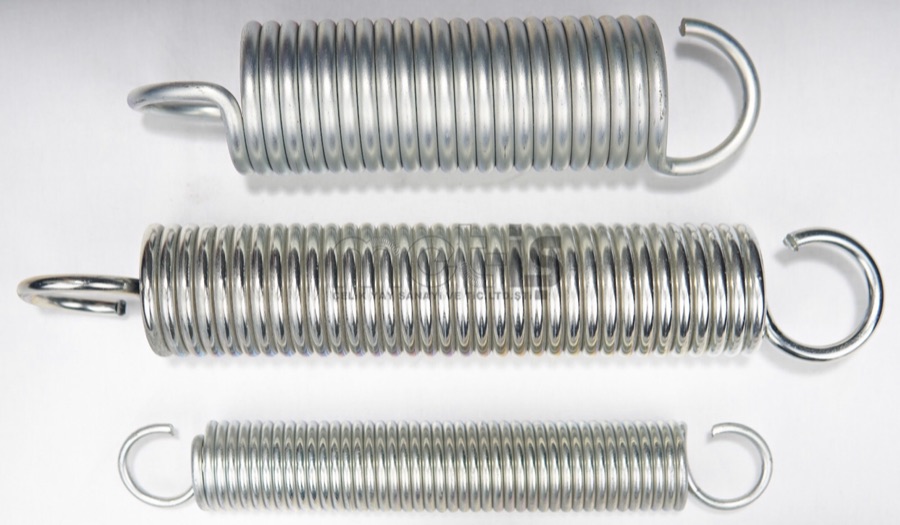
The natural answer to a tensioning job is an extension spring: closed coils with a hook or loop at each end, producing a counter force when pulled apart. In some awning mechanisms a torsion spring works in the take-up roller instead — the type that is wound as the arm opens and returns its energy as it closes.
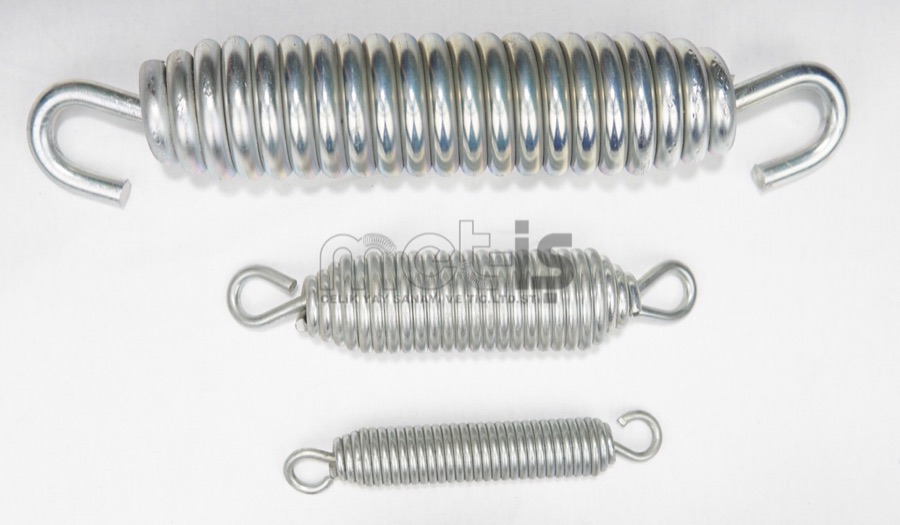
On an extension spring most failures begin not in the body but in the hook. The reason is geometric: the body works in torsion while the hook works in bending, and stress concentrates where the bend radius of the hook tightens. Hook form is therefore as decisive as wire diameter on a tarpaulin spring. An open hook is easy to fit but can open under load; a closed or long English hook is safer.
Galvanised finish is standard. Where corrosion is severe — coastal sites, inside greenhouses, chemical contact — the material itself is the answer rather than a coating, and stainless spring wire is used. An uncoated tension spring weakens before it breaks: corrosion lowers the force through loss of cross-section, and the cover slackens without anyone noticing.
Dimensions and ordering
Tarpaulin tension springs are not listed as ready items in our catalogue; this group is made to dimensions. Because the coiling line works without tooling dependency that is not a drawback: you do not need to commission tooling for the size you want, and single-piece production is possible.
The dimensions we need on an extension spring are wire diameter, outside diameter, free length including hooks, coil count and hook form. In addition we need to know the length the spring will work to — its extended length once fitted. On a tensioning spring that is the figure that really defines the part.
If you have the old spring the job is simple: it is reproduced exactly from the sample. If you cannot measure, a photograph of the old part next to a ruler is enough for most items. With neither dimensions nor a sample, we work it out together from a photograph of the mechanism and the distance between the two points the spring will span.
Working conditions by application
The spring does the same work in all three; the working environment decides material and finish.
| Application | What the spring does | Governing condition |
|---|---|---|
| Truck / lorry / trailer tarpaulin | Holds the edge rope and side curtains taut | Vibration, road salt, frequent opening |
| Shop and balcony awning | Balances the arm and the take-up roller | Sun, rain, low cycles, years outdoors |
| Greenhouse and cover system | Holds sheeting taut against thermal movement | Damp, agricultural chemicals, corrosion |
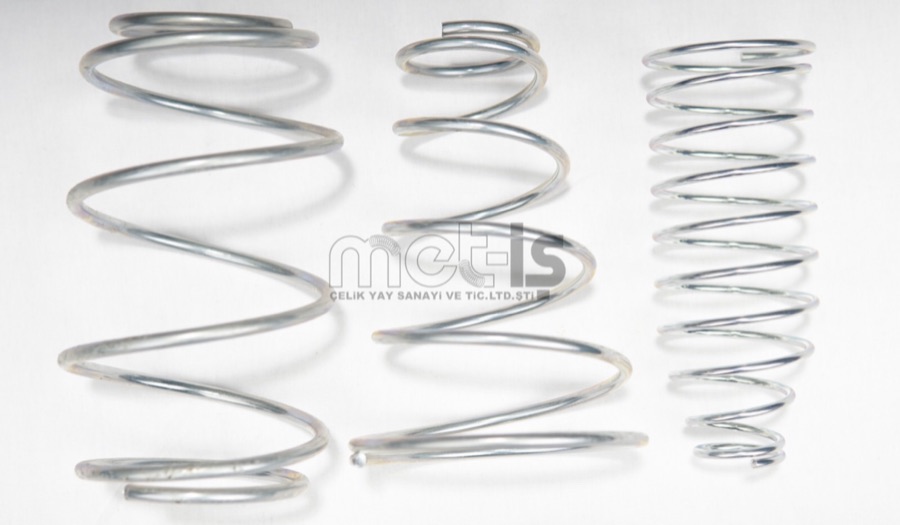
Photographs from production
Frequently asked questions
Is an awning spring the same as a tarpaulin tension spring?
Yes — two names for the same part. "Awning spring", "tarpaulin spring", "tarpaulin tension spring" and "tensioning spring" all describe the same hooked extension spring. It makes no difference which term you use when ordering.
Do you make springs for automatic tarpaulin systems?
We do not make the systems themselves — we are a spring manufacturer. The tension and take-up springs that work inside automatic tarpaulin mechanisms can be produced from a sample or from dimensions. Send us the old spring and an exact replacement is made.
Do you make stainless tarpaulin tension springs?
Yes. Where corrosion is severe — coastal sites, inside greenhouses, chemical contact — stainless spring wire is used instead of a galvanised finish. Which material suits is settled at the quotation stage according to where the spring will work.
Which spring is used on greenhouse sheeting?
Hooked extension springs that hold the sheet taut along the profile. The real difficulty is that the sheet expands as it warms during the day and contracts at night, so the spring needs a working range that absorbs that daily movement. Damp and chemical contact also make corrosion resistance important.
How do I measure?
On an extension spring we need wire diameter, outside diameter, free length including hooks, coil count and hook form. We also need the extended length once fitted — on a tensioning spring that is the figure that really defines the part. If you cannot measure, a photograph of the old part next to a ruler is enough for most items.
Can I order a single piece?
Yes. Because the coiling line works without tooling dependency, single-piece production is possible and there is no tooling cost. Unit cost falls as quantity rises, so stating quantity with your enquiry is the way to get the most accurate price.
Related pages
Cannot find the spring you need?
We produce to your dimensions in the 0.20–40 mm wire range, with no tooling dependency. A sample, a technical drawing, or simply a photograph of the old spring is enough.
Fill in the quote formOr call us directly: 0850 840 54 17