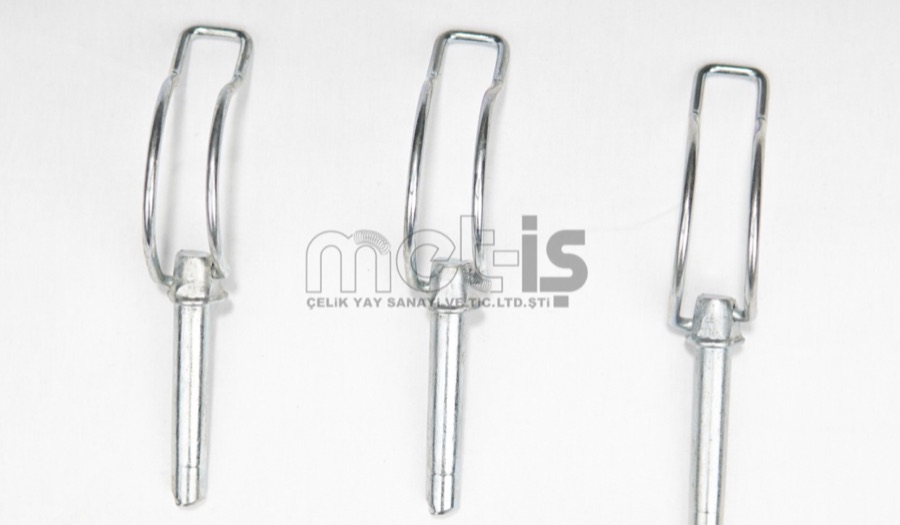
Lynch Pins and Hairpin Clips
Lynch pins, R clips, D pins, square pins, drawbar pins and hairpin clip series used on agricultural machinery. Lynch pins in 4, 5, 6, 8 and 10 mm; hairpin clips 3–5 mm. Custom sizes included.
About Lynch Pins and Hairpin Clips
The lynch pin and the hairpin clip are the smallest parts securing a connection on a farm machine — and the ones most often lost. They are used everywhere from the PTO shaft to the drawbar, from the opener shoe to the rake group, which makes them the first item a farmer keeps in stock.
What a lynch pin does is simple but critical: it keeps a shaft or a connecting pin in place. A plain pin walks out under vibration; the spring leg of a lynch pin, locking back onto the body, prevents that. Because the leg opens and closes by hand, no tool is needed to fit or remove it — which is exactly what is wanted when a machine has to come apart in the field.
Two dimensions decide the choice: the pin body diameter and the effective length. Body diameter follows the hole; effective length must exceed the thickness of the connection. On R clip type hairpin clips the spring force of the leg matters as well — a weak leg works itself out under vibration.
The international equivalent of an agricultural lynch pin is DIN 11023, a 1979 standard titled simply “Agricultural machinery — Linch pins”. The same part is known in the field as a lynch pin or a locking pin. You do not need the standard number to order — the body diameter and the effective length are enough, because production follows the dimensions given.
Our catalogue holds 4, 5, 6, 8 and 10 mm lynch pins, 6/8/10 mm D pins, an 8 mm square pin, a drawbar pin and a 3–5 mm hairpin clip series. D pins are produced with a spring ring. If a size is not on the list it is produced from a sample or from dimensions — there is no tooling dependency on the pin side.
How to take the dimensions of a lynch pin
A mix-up over dimensions is the commonest reason the wrong part arrives. Four measurements are enough to order; all of them can be taken from the old part with a caliper or a ruler.
- Body diameter — the diameter of the straight body of the pin. This is the figure catalogues use as the name of the product: “8 mm lynch pin” means the body diameter. It is chosen to suit the hole it goes into.
- Effective length — the length of the working part of the body that passes through the connection. It must be longer than the combined thickness of the parts being joined, otherwise the spring leg has nowhere to close.
- Overall length — the length measured end to end. In tight positions this is what decides whether the pin will fit at all.
- Spring leg / ring size — the opening of the spring that closes over the body, and the thickness of its wire. These set the closing force of the leg; a weak leg works itself out under vibration.
DIN 11023 nominal sizes
The international reference for an agricultural machinery lynch pin is DIN 11023, titled “Agricultural machinery — Linch pins”. The standard identifies a pin not by a single diameter but by a nominal size pair — diameter and length are always quoted together. The 6, 8 and 10 mm lynch pins in our catalogue are produced to these nominal sizes:
- 5 × 32 — the smallest nominal size.
- 6 × 42 — the 6 mm lynch pin in our catalogue is produced to this nominal size.
- 8 × 42 — the 8 mm lynch pin in our catalogue is produced to this nominal size.
- 10 × 45 — the 10 mm lynch pin in our catalogue is produced to this nominal size.
- 12 × 45 and 12 × 55 — two lengths of the same diameter; the length is chosen to suit the thickness of the connection.
- 17 × 60 — the largest nominal size, for heavy connections.
What “8 mm pin” actually means in the field
A lynch pin is named for the hole it goes into, not for its own body diameter. When an “8 mm lynch pin” is asked for, what is meant is a pin that fits an 8 mm hole; the measured diameter of the body sits a little under that figure, because the pin has to go in and come out without binding. It is therefore normal for an old part not to measure exactly 8.00 mm under a caliper.
For the same reason one maker’s “8 mm” and another’s can differ by tenths. As long as the nominal size is the same, both go into the same hole; the difference lies in the tolerance the maker has chosen.
When ordering, the soundest route is to state the diameter of the hole, or to send the old part — then the question of tolerance never arises.
Why another maker’s dimension table cannot be copied
Lynch pin tables given with letters such as d1, d2, l1, l2, b1 and b2 circulate widely online. Those letters are not a standard: the same letter can denote the body diameter in one maker’s table and the ring opening in another’s. In comparing records that use the same letter set, we have seen l1 point to different quantities.
Copying a table and ordering from it is therefore risky. The safe route is always the same: measure the old part in your hand, or lay it next to a ruler and photograph it. If you have a sample there is no need to measure at all — an exact copy is produced.
The international reference for an agricultural machinery lynch pin is DIN 11023, but you do not need to know the standard number; the body diameter and the effective length are enough.
Where it is used on tractors and agricultural machines
A lynch pin does its work wherever a shaft or connecting pin must be stopped from working its way out. On the tractor and implement side it turns up most often at these connections:
- Drawbar and hitch — the point where a trailer or field implement connects to the tractor. A pin that walks out here means the implement comes away.
- PTO shaft connections — holding the shaft on axis in shaft and guard assemblies.
- Seed drill opener assembly — on the shoe and press arm connections.
- Rake and comb bar assemblies — on the shaft connections of the tine carrier bars.
- Three-point linkage and top link — securing the link pins; here it usually works together with a hairpin clip.
What it is also called in the field
The same part is asked for under different names depending on the region and the seller. Locking pin, safety pin, retaining pin and quick-release pin usually all mean the same lynch pin. It is spelled both lynch pin and linch pin; because the ring is R-shaped it is also called an R-pin.
The same is true of the hairpin clip: R-clip, R-pin hairpin and hairpin cotter are the same part. One distinction does matter — a split pin (cotter pin) is NOT a lynch pin: it has no spring, it is secured by bending its legs after fitting, and it is not reused once removed.
Which name you use when ordering makes no difference; the body diameter and a photograph of the part in your hand are enough.
What sets the price
There is no single list price for a lynch pin, because the same pin costs many times more or less depending on quantity. Four things set the price: size, quantity, coating and packing. The most decisive of these is quantity — setting up the coiling line is a fixed job that is divided by the quantity, so one piece and a thousand pieces come off the same line but not at the same price.
Stating the quantity when you ask for a quotation is therefore the fastest route to an accurate price. Naming the coating you want — galvanized or stainless — settles it further.
We are the manufacturer, not a dealer: the pin is coiled in our own plant, and because there is no tooling dependency a size that is not on the list carries no tooling cost.
Product list — 10 items
The items below are supplied from stock or made to order. The link at the end of each row carries the product into the quote form.
| No. | Product name | |
|---|---|---|
| 122 | 4 mm Lynch pin | Request a quote |
| 123 | 5 mm Lynch pin | Request a quote |
| 88 | 6 mm Lynch pin | Request a quote |
| 89 | 8 mm Lynch pin | Request a quote |
| 90 | 10 mm Lynch pin | Request a quote |
| 91 | 6 mm D hoe pin | Request a quote |
| 92 | 8 mm D pin | Request a quote |
| 93 | 10 mm D pin | Request a quote |
| 94 | 8 mm Square pin | Request a quote |
| 124 | Drawbar pin | Request a quote |
Photographs from production
How it is made
Every step after coiling happens in our own plant; nothing is outsourced. This shortens lead times and keeps quality responsibility in one pair of hands.
CNC spring coiling
Formed in the 0.20–40 mm wire range.
Tempering
Stress is relieved and elasticity becomes permanent.
End grinding
Seating faces are flattened on compression springs.
Galvanizing
Surface protection against corrosion.
Packaging
Domestic and international logistics included.
FAQ
Do your pins conform to DIN 11023?
Yes. The 6, 8 and 10 mm lynch pins in our catalogue are produced to DIN 11023 nominal sizes — 6×42, 8×42 and 10×45 respectively. The standard is titled “Agricultural machinery — Linch pins” and is the international reference for this part.
How is a lynch pin fitted?
Pass the body through the connection hole, then press the spring leg down over the body by hand. No tool is needed. To remove it, open the leg with your thumb and pull the body back out. The detailed difference between the types, and fitting and removal, are covered in our lynch pin guide.
How much does a lynch pin cost?
There is no single list price. Price is set by size, quantity, coating and packing — and quantity is the most decisive of these. Stating the size and the quantity on the quote form is the fastest route to an accurate price.
Which lynch pin size does a tractor use?
There is no single answer — it depends on the connection point. The sizes asked for most often in the field are 6, 8 and 10 mm; our catalogue also carries 4 and 5 mm. The right method is to measure the body diameter of the old part, or, if you cannot measure, photograph it next to a ruler.
Can I use dimension tables found online?
Be careful. Letters such as d1, d2, l1 and l2 are not a standard: the same letter can mean the body diameter at one maker and the ring opening at another. Rather than copying a table, measure your own part or send a photograph of it.
Is a split pin the same as a lynch pin?
No. A split pin (cotter pin) has no spring; it is secured by bending its legs apart after fitting and cannot be reused once removed. A lynch pin locks with its spring leg, is fitted and removed by hand, and is used many times over.
What does a lynch pin do?
It keeps a shaft or a connecting pin in place. A plain pin walks out under vibration; the spring leg of a lynch pin locks back onto the body and prevents that. The leg opens and closes by hand, so no tool is needed.
How is a lynch pin size chosen?
Body diameter follows the hole it fits, and the effective length is chosen to exceed the total thickness of the connection. Catalogue sizes are 4, 5, 6, 8 and 10 mm; anything outside those is produced from a sample or from dimensions.
What lynch pin sizes do you produce?
The catalogue holds 4, 5, 6, 8 and 10 mm lynch pins. D pins come in 6, 8 and 10 mm and the square pin in 8 mm. For sizes not on the list, a sample or a set of dimensions is enough.
Is a lynch pin the same as a locking pin?
Yes — two names for the same part in the field. The standard for agricultural machinery is DIN 11023.
Do you produce drawbar pins?
Yes, it is in the catalogue. The pin used on trailer and drawbar connections works together with a lynch pin or a hairpin clip for security.
My R clip works itself out under vibration — why?
The spring force of the leg has weakened. A fatigued clip works itself out under vibration and needs replacing.
What is the difference between a D pin and a lynch pin?
A D pin has a D-shaped spring ring and suits quick fitting and removal by hand. Our catalogue holds 6, 8 and 10 mm sizes.
What hairpin clip sizes do you produce?
The catalogue holds 3, 4 and 5 mm hairpin clips; other sizes can be produced to order.
How is size confusion avoided on bulk orders?
Sizes are packed separately for despatch; you only need to state the size on the order line.
Where is a square pin used?
It is preferred where rotation must be prevented; our catalogue holds it in the 8 mm size.
Other machine groups
Cannot find the spring you need?
We produce to your dimensions in the 0.20–40 mm wire range, with no tooling dependency. A sample, a technical drawing, or simply a photograph of the old spring is enough.
Fill in the quote formOr call us directly: 0850 840 54 17