
Extension Springs
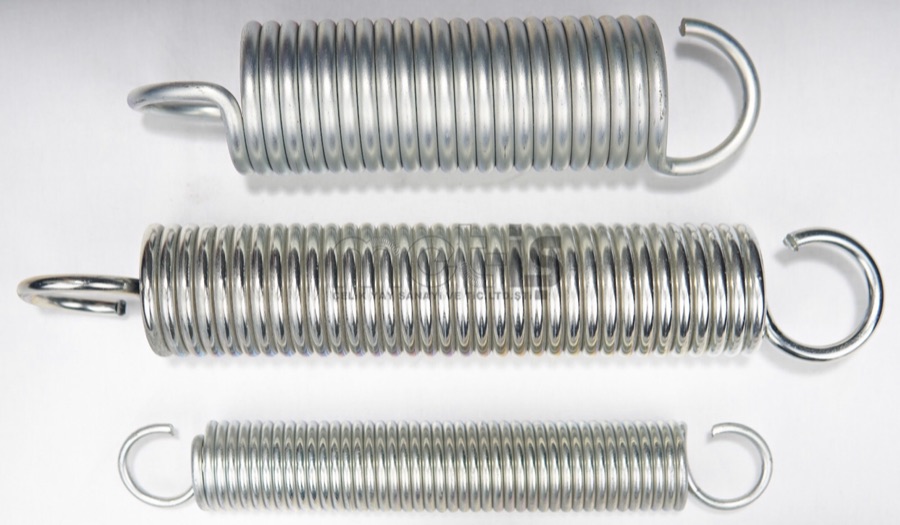
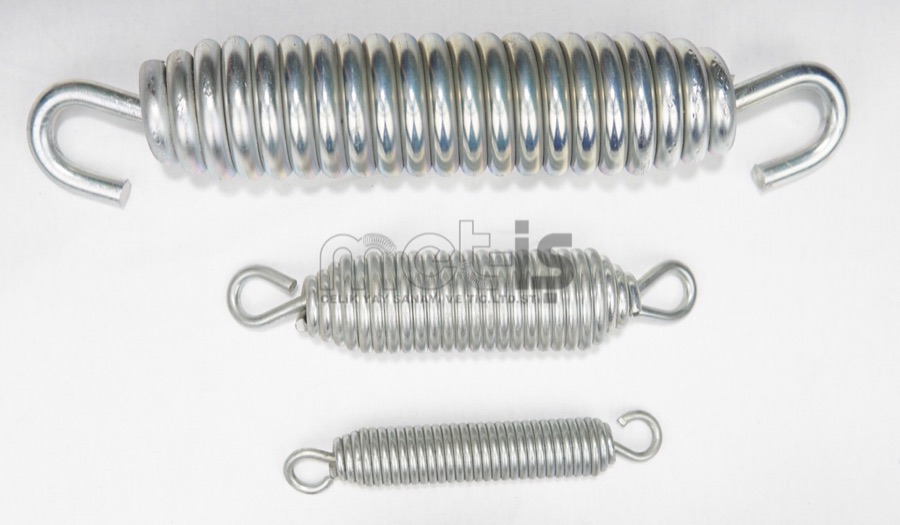
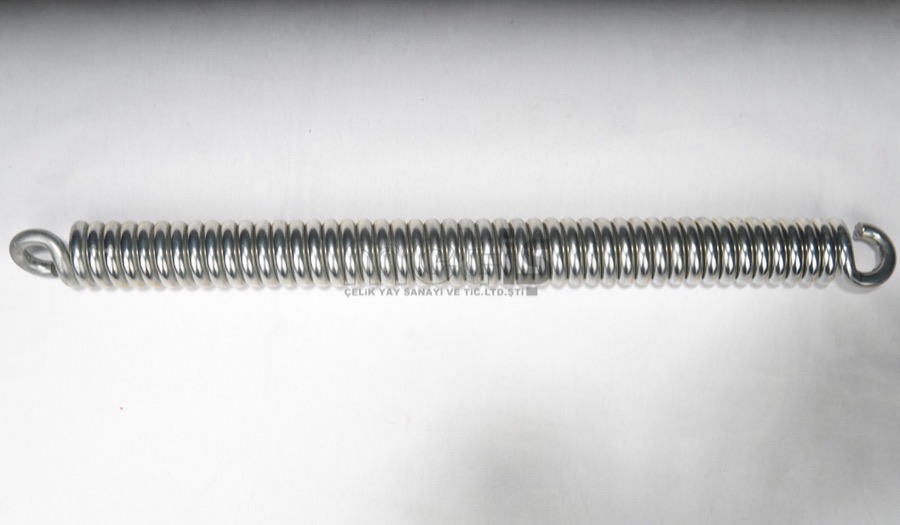
Springs that produce a counter force when pulled apart, with closed coils and a connection form at each end. We manufacture them with hook, loop and threaded end options.
How extension springs work
Unlike a compression spring, an extension spring is coiled so that its turns touch one another. Those closed coils are not merely a shape preference: they allow initial tension to be set into the wire during coiling. A spring with initial tension does not extend at all until a certain force is reached, and only opens beyond that threshold. Part of what is called "the spring has gone soft" in the field is not breakage but the loss of this initial tension.
Once the body does begin to open, the spring rate follows exactly the same relation as a compression spring: k = G·d⁴ / (8·Dm³·n). Body behaviour is identical in both types; the difference lies at the ends.
The weakest point of an extension spring is not its body but its hook. The entire load passes through the bend radius of the hook and stress concentrates there, which is why the great majority of breakages happen at the root of the hook. Increasing the bend radius reduces that concentration; where space allows, a generous hook radius gives longer life.
The end type also determines assembly. A hook end fits quickly and is practical in field conditions, while a threaded end allows initial tension to be adjusted in place. Confirming the existing end type on the machine before ordering prevents surprises during fitting, because changing the end type also changes the free length measured over the hooks.
Extension springs in our catalogue run from forage harvester ball springs to mower drum suspension springs, and from sprayer arm springs to baler groups. When giving dimensions it matters whether the free length includes the hooks; if only the body length is quoted, two springs can look identical and behave differently.
Hook and loop types
The "end type" field on the quotation table expects one of these. The hook form is not only an assembly question: it sets the bend radius the load passes through, and therefore where the spring will fail.
- German loop (half loop) — the wire end is bent so it stays within the body diameter and adds no length. The most common form on agricultural and general machine items.
- Machine loop (full loop) — a full loop on the body axis. It carries the load in line and raises no orientation problem at assembly.
- Side loop — the loop sits to the side of the body. Used in tight seats where there is no room on the axis.
- Extended hook — the loop is drawn away from the body; where the anchor point is far from the body, the hook covers the distance.
- Hook angle — the angle between the two hooks (same plane or 90°) is made in the same plane unless stated on the order.
Material and standard
The hook bend is where the wire is worked hardest, so ductility matters as much as tensile strength. Two wire families are used in production, each defined by its own European standard.
- Carbon spring steel wire — EN 10270-1. Known in the field as Ck67, Ck75, C60 and C70. Galvanised standard agricultural and machine items come from this family.
- Stainless spring wire — EN 10270-3. 1.4310, AISI 302 and 304 are different designations of the same family.
- Wire diameter range — the coiling line works between 0.20 mm and 40 mm.
- Class code — the SL, SM, SH, DM or DH code on the wire certificate marks the tensile strength band. Set out in the spring steel guide.
Dimensions we need for a quotation
On an extension spring, stating whether the length is measured over the hooks or not is the single detail that prevents the most mistakes.
| Dimension | What it means |
|---|---|
| Wire diameter · d | The diameter of the wire the spring is coiled from. |
| Outside diameter · Dd | Outer measurement of the body; mean diameter Dm = Dd − d. |
| Free length · L₀ | End-to-end length including hooks, unloaded. Please state which measurement you are giving. |
| Body length · Lk | Coil length excluding hooks; approximately (n+1)·d. |
| Coil count · n | The number of closed coils. |
| End type | Hook, loop or threaded end. A threaded end is chosen where initial tension has to be adjusted. |
Extension Springs calculator
Enter your dimensions and we will return the spring rate, solid length and spring index instantly — with a warning if the index leaves the healthy band.
Photographs from production
Which machine groups use it
Springs of this type appear in the following groups in our catalogue, each listed in detail on its own page.
How it is made
Every step after coiling happens in our own plant; nothing is outsourced. This shortens lead times and keeps quality responsibility in one pair of hands.
CNC coiling
Formed across the 0.20–40 mm wire range.
Tempering
Stress is relieved; elasticity becomes permanent.
End grinding
Seating faces are flattened on compression springs.
Galvanising
Surface protection against corrosion.
Packing
Domestic and export logistics included.
Frequently asked questions
What is initial tension in an extension spring?
It is the force set into the wire during coiling that presses the turns against each other. The spring does not begin to extend until that force is exceeded. Initial tension is a production parameter and can be set to the value you need.
Why do springs always break at the root of the hook?
The entire load passes through the bend radius of the hook and stress concentrates there. Increasing the bend radius reduces that concentration; where space allows, a generous hook radius gives longer life.
Should free length be measured over the hooks?
It is enough to state which measurement you took. Length over the hooks is the common convention; if only the body length is given, two springs can look identical and behave differently.
What is the difference between hook and threaded ends?
A hook end fits quickly and is practical in the field. A threaded end allows initial tension to be adjusted in place. The choice follows the existing connection type on the machine.
Does an extension spring have a solid length?
No — solid length does not apply to extension springs; the limit is on the extension side. A spring pulled too far takes on permanent length once the gap between coils has opened.
Can you reproduce a spring that has broken?
Yes. With the broken part in hand, wire diameter, outside diameter and coil count are measured to recover the original geometry; a photograph is enough for the hook form.
Other spring types
Cannot find the spring you need?
We produce to your dimensions in the 0.20–40 mm wire range, with no tooling dependency. A sample, a technical drawing, or simply a photograph of the old spring is enough.
Fill in the quote formOr call us directly: 0850 840 54 17