
Agricultural Machinery Springs
Every steel spring that works on agricultural implements and machinery, from balers and seed drills to hay rakes and tractor seats — 124 items, 11 machine groups, 41 machine brands, made in Biga since 1978.
Why agricultural springs are a trade of their own
An industrial spring and an agricultural machinery spring are calculated the same way, but they do not work under the same conditions. A spring inside a machine works clean, dry, at a steady temperature and over a known number of cycles. A field spring works in soil, stone, moisture and stubble; its load is impact-driven and irregular, its cycle count varies with the season, and the place it is removed and refitted is usually the middle of a field rather than a workshop.
That has three practical consequences. First, what governs is fatigue life rather than static strength — the spring has to last not until it breaks, but until it can no longer do its job. Second, coating is functional rather than cosmetic: corrosion lowers spring force through loss of cross-section, which is why a galvanised finish is standard on agricultural items. Third, dimensional tolerance matters as much as ease of fitting; a spring bent into place in the field loses its form in its first season.
These three reasons are what separate agricultural springs from general spring manufacturing. Almost every item in our catalogue is produced with a wire and heat treatment regime chosen for these conditions.
Which spring works on which machine
The table below shows which spring family predominates in each of the 11 machine groups in our catalogue. More than one type can appear on the same machine — the baler is the extreme case, carrying five different spring characters on one machine.
How many names does one part have
The most common difficulty in agricultural spares is that the same part is called something different from region to region. One customer looks for a "helicopter spring" while another calls the same part a "windrow spring" and a third a "rake spring". The list below collects the field names that have a match in our catalogue — it does not matter which one you use when ordering, they all lead to the same item.
- Helicopter spring · windrow spring · pickup spring — the torsion type form spring on the rotating arm of a gearbox-driven rotary rake. Listed in the hay rake group under brand names.
- Rake spring · tine · pickup spring — the spring in the group that moves crop from the ground into the feed channel on a baler. The rake plate is the sheet part the spring mounts to, not the spring itself.
- Fork spring — works in the feeder fork group that pushes crop into the chamber on a baler. Two items in the catalogue: the 8 mm fork spring and the 2.5 mm fork adjustment lever spring.
- Pad pressure spring — the chamber pressure group that sets bale density. Three separate items: upper pad, cradle pad and shear pad.
- Spoon spring · cup spring — the spring in the tying (shuttle) group. Listed as the conical spoon spring and the U cup connection spring.
- Ratchet pressure spring — holds the pickup flow arrangement; listed as the 6 mm rake ratchet pressure spring.
- Shear key spring — in the safety group, the spring of the connection designed to fail under overload.
- Press wheel · coulter spring — two separate groups that hold sowing depth constant on a seed drill. The catalogue carries separate items by brand.
If you need a spring that is not in the catalogue
Our catalogue is not everything we can make; it is a list of what is asked for most. Our coiling line works across the 0.20 to 40 mm wire diameter range with no tooling dependency, which means you do not need to commission tooling for an item that is not on the list.
Production can start from any of three things: a sample (the old spring itself), a technical drawing, or dimensions. For the dimensional route we need wire diameter, outside diameter, free length and coil count on compression and extension springs; on torsion and form springs, leg length and leg angle as well. If you cannot measure, a photograph of the old part next to a ruler is enough for most items.
The spring calculator on this site takes those dimensions and works out the spring rate, the working length and, on compression springs, the safety factor, then draws a technical drawing sheet. Sending a screenshot of that sheet with your enquiry is the fastest route.
Machine group and spring family
The 11 machine groups in our catalogue and the spring type that predominates in each.
| Machine group | Predominant spring type | Typical working condition |
|---|---|---|
| Baler | Torsion form · compression · extension | Impact loads, high cycle count |
| Hay rake (helicopter) | Torsion form, double-legged | Impact loads, stone contact |
| Seed drill | Compression · form | Soil and moisture contact, steady load |
| Combine harvester | Torsion form | High cycle count, dust |
| Forage harvester | Extension | Constant preload under vibration |
| Tractor seat | Compression · extension | Suspension cycles, enclosed environment |
| Beet / groundnut | Compression · form | Soil, stone, abrasion |
| Cultivator | Heavy duty form | High static load, impact |
| Sprayer | Extension · form | Chemical contact, corrosion |
| Mower | Extension (drum suspension) | Vibration, steady load |
| Lynch pins | Wire form | Fitted and removed by hand, fatigue |
Categories by machine group
Each category page carries the item list for that group, compatible brands and group-specific questions.
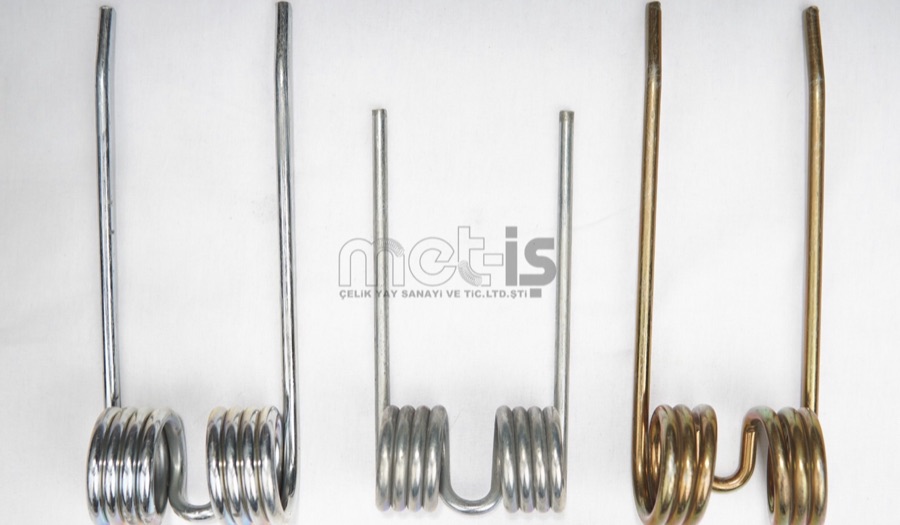
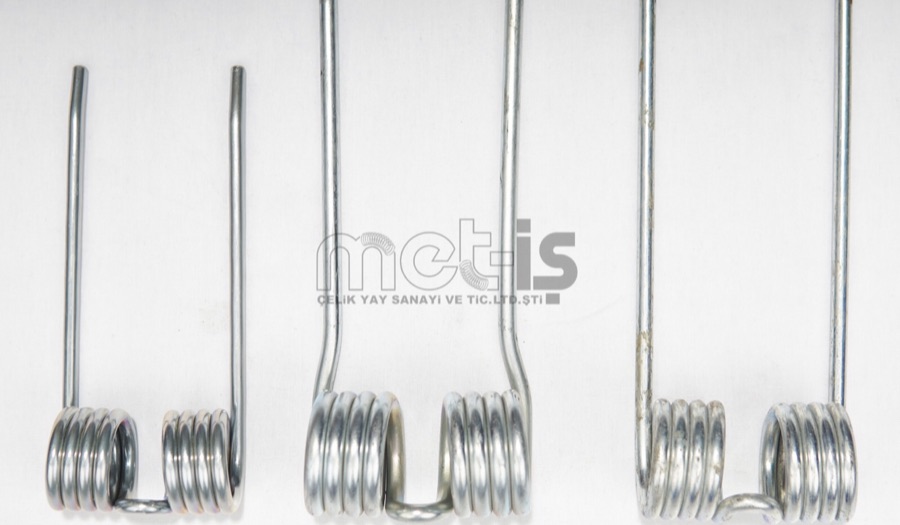
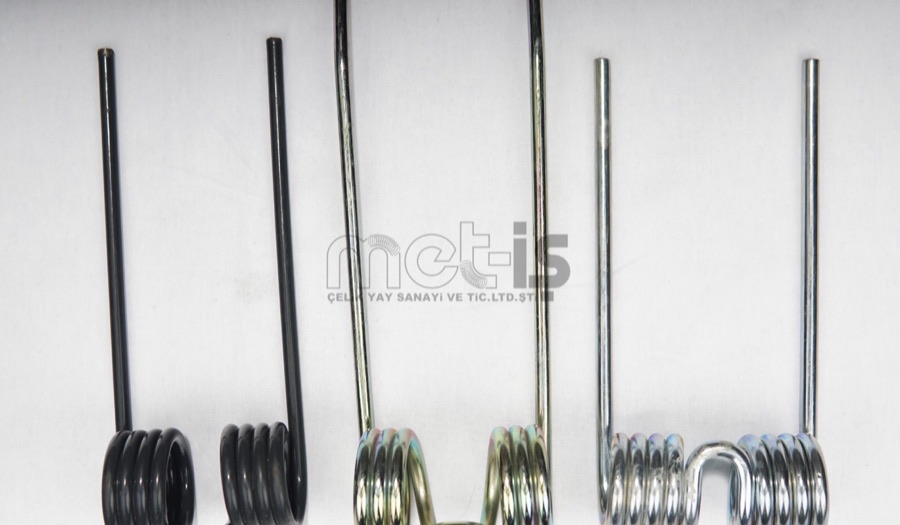
Photographs from production
Frequently asked questions
What is the difference between an agricultural spring and an industrial spring?
The calculation is the same, the working conditions are not. A field spring works in soil, stone, moisture and stubble under impact loads; what governs is fatigue life rather than static strength, and coating is functional rather than cosmetic.
Which machine groups do you make springs for?
Baler, hay rake, seed drill, combine harvester, forage harvester, beet harvester, cultivator, sprayer, mower and tractor seat groups, plus lynch pins — 11 groups and 124 items in our catalogue.
My machine brand is not on the list — can you still make it?
Most likely yes. The catalogue lists what is asked for most, not everything we can make. Our coiling line works across the 0.20–40 mm wire range with no tooling dependency; we produce from a sample or from dimensions.
I do not know the name of the spring I need — how do I describe it?
Saying where the part sits on the machine (pickup, fork, pad pressure, latch, press wheel) is more useful than brand and model. A photograph of the old part next to a ruler is usually enough as well.
Will your springs replace the original part?
Springs are produced from the wire diameter, body dimensions, coil direction and leg form of the original part, and fit without modification to the machine.
Do you sell single parts or wholesale only?
Both. We supply single replacement parts as well as series production for machinery manufacturers. Send quantities and items through the quote form.
Related pages
Cannot find the spring you need?
We produce to your dimensions in the 0.20–40 mm wire range, with no tooling dependency. A sample, a technical drawing, or simply a photograph of the old spring is enough.
Fill in the quote formOr call us directly: 0850 840 54 17