
Choosing Spring Steel
Three things decide the life of a spring: geometry, heat treatment and material. The first two are controlled by calculation and production; the third is chosen to suit the working environment. This article sets out the questions asked when making that choice.
2026-09-128 min readMetiş Yay
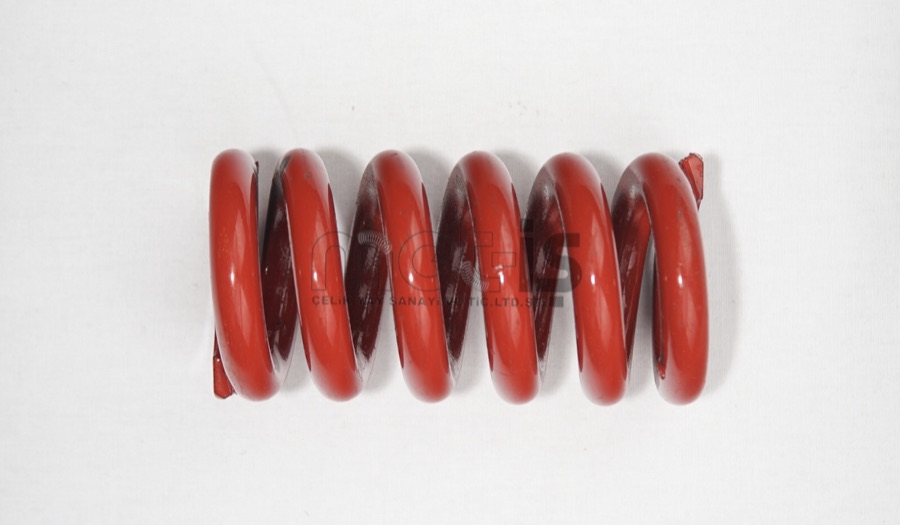
What spring steel is
Spring steel is steel that deforms under load and returns to its original length once the load is removed. Not every steel does this: ordinary structural steel stretches permanently above a certain stress and does not come back. What sets spring steel apart is the width of the stress range it accepts before it takes a permanent set.
That property comes from two things: a high carbon content, or alloying elements such as chromium and vanadium, together with the heat treatment applied on top. So "spring steel" is not one material name but a family name describing a behaviour. Two wires sold under the same name can differ considerably in chemistry and strength.
Coiling alone does not deliver that behaviour. Stress remains locked in the wire after coiling; unless it is relieved by tempering, the spring settles under the first load and loses its force. Material choice and heat treatment are therefore not separate decisions but two halves of one.
Types of spring steel and their standard codes
Three families come up in ordering correspondence. The distinction is in the chemistry: whether carbon works alone, whether alloying elements are added, or whether corrosion resistance is provided by chromium and nickel.
Older German names for these families are still in common use. Codes such as "Ck67", "Ck75" and "C60" refer to carbon spring steel wire; "51CrV4" is chromium-vanadium alloyed spring steel; and on the stainless side 1.4310 and AISI 302 are two designations for the same material.
| Material family | Standard | Names used in the field |
|---|---|---|
| Carbon spring steel wire | EN 10270-1 | Ck67 · Ck75 · C60 · C70 |
| Stainless spring wire | EN 10270-3 | 1.4310 · AISI 302 · 304 |
| Chromium-vanadium spring steel | EN 10089 | 51CrV4 · 1.8159 |
What SL, SM and SH mean — the EN 10270-1 class codes
On a wire certificate, next to the material name, sits a two-letter code: SL, SM, SH, DM or DH. The code does not describe the quality of the wire but the duty it was drawn for and the strength level it was drawn to. Turkish sources usually print the code without its meaning; yet when placing an order the meaning is exactly what matters.
The first letter is the duty: S for static, D for dynamic. The static classes are for springs working under constant or rarely changing load. The dynamic classes are asked for when loading repeats frequently, or when the spring index is small and the wire is bent around a tight radius. The second letter is the strength level: L low, M medium, H high.
All the wire we coil at the Biga plant is EN 10270-1+A1 class SM — static duty, medium strength. That matches the working regime of agricultural implement and machinery springs. Where a dynamic class is required, the wire is sourced separately and we state it at the quotation stage.
| Code | Duty | Strength level |
|---|---|---|
| SL | Static | Low |
| SM | Static | Medium — the class we use |
| SH | Static | High |
| DM | Dynamic | Medium |
| DH | Dynamic | High |
Strength falls as diameter rises — the values on our own certificates
The strength of spring steel is not a single number; it depends on wire diameter and falls as the diameter rises. The cause is not heat treatment but the drawing process itself: thin wire sees more deformation as it is drawn, its structure is refined further, and it reaches a higher strength. Thicker wire sees less deformation, so its strength sits lower.
The table below does not come from a standards book. It was read off the mill certificates of the wire we coil: sixteen certificates, fifteen diameters, all EN 10270-1+A1 class SM. "Standard range" is the band within which the wire is acceptable for that diameter; "measured" is what the batch delivered to us actually produced. Images of the certificates are on our certificates page.
The practical meaning: a spring coiled from 12 mm wire is not made of a "weaker" material than one coiled from 1.8 mm wire — both sit inside their own band, the bands simply differ. The strength to use in a spring calculation is the one on that diameter's own row. Using a single average figure instead makes the safety margin on thick wire look larger than it is.
| Wire diameter | Standard range (N/mm²) | Measured on the certificate (N/mm²) |
|---|---|---|
| 1.80 mm | 1,790 – 2,010 | 1,870 – 1,890 |
| 2.00 mm | 1,760 – 1,970 | 1,880 – 1,910 |
| 2.50 mm | 1,690 – 1,890 | 1,700 – 1,710 |
| 3.00 mm | 1,630 – 1,830 | 1,710 – 1,720 |
| 4.50 mm | 1,500 – 1,680 | 1,620 – 1,680 |
| 5.00 mm | 1,460 – 1,650 | 1,500 – 1,640 |
| 5.50 mm | 1,430 – 1,610 | 1,510 |
| 6.00 mm | 1,400 – 1,580 | 1,450 |
| 7.00 mm | 1,350 – 1,530 | 1,450 – 1,460 |
| 7.50 mm | 1,330 – 1,500 | 1,430 – 1,440 |
| 8.00 mm | 1,310 – 1,480 | 1,390 – 1,400 |
| 9.00 mm | 1,260 – 1,440 | 1,380 – 1,390 |
| 11.00 mm | 1,210 – 1,370 | 1,230 – 1,260 |
| 11.50 mm | 1,210 – 1,360 | 1,290 – 1,330 |
| 12.00 mm | 1,180 – 1,340 | 1,180 – 1,290 |
First the question: where will the spring work?
Material choice is not settled by asking which is stronger. Three conditions govern: the size of the load and how often it repeats, the corrosion risk of the environment, and the working temperature.
On agricultural machinery the first two dominate. A seed drill spring in constant contact with soil and moisture does not call for the same material as a contact spring inside a sealed mechanism.
Spring steel — general use
The great majority of items in our catalogue are made from spring steel. It offers high strength and good fatigue behaviour, and it is the standard choice for compression, extension and torsion springs on agricultural machinery.
Its weak point is corrosion: bare spring steel rusts in damp conditions, and rust both removes cross-section and creates crack initiation sites. Surface protection is therefore part of the choice rather than a separate decision.
Stainless — where corrosion governs
Where chemical exposure is high — sprayer arm and wing springs, for example — stainless material is considered. What it buys is life: once corrosion stops, fatigue life approaches its design value.
In return, stainless works at a different strength level from spring steel of the same size, so changing the material usually means the geometry has to be reviewed as well. The two decisions are taken together.
Chrome silicon — heavy and impact loading
For springs working at high stress and under impact, alloyed spring steels such as chrome silicon are preferred. They offer higher fatigue strength and better behaviour at temperature.
In thick-wire, impact-loaded groups such as heavy cultivator springs, heat treatment matters as much as material: a thick-wire spring coiled without stress relief takes a permanent set on the first heavy impact whatever it is made of.
Does spring steel rust?
Carbon spring steel does. There is no chromium in it to provide corrosion resistance, and a bare spring rusts quickly in damp conditions. So the real question is not whether it rusts but what happens when it does.
The answer bears directly on the spring's job. Rust first eats cross-section; as the wire thins the spring rate falls and the spring slackens without anyone noticing. The second and more dangerous effect is that corrosion pits act as crack initiation sites — fatigue failures almost always start from a surface defect like that. Corrosion does not merely make a spring look bad; it shortens its life.
There are two remedies and they are not the same thing. The first is coating: galvanising covers the surface and is standard in our production. The second is changing the material itself: stainless spring wire contains chromium and nickel, so its corrosion resistance is in the material rather than on the surface and survives a scratch. A coating fails from the point where it is damaged; where damp or chemical contact is constant, stainless is preferred.
Coating is not a substitute for material
Galvanised coating protects the surface against corrosion and is standard in our production. Hay rake and tine springs are also produced with silver, gold and black finishes.
But coating is not a change of material: the mechanical properties of the spring are set by the wire material and the heat treatment, while the coating provides surface protection and appearance. Choosing a coating colour does not change strength.
Strength values and the calculator
The calculator on our home page shows the permissible stress and safety factor for the selected material. The calculation rests on three values: shear modulus G, elastic modulus E and tensile strength Rm. The table below gives exactly the figures the calculator uses.
| Material | Shear modulus G | Elastic modulus E | Tensile strength Rm |
|---|---|---|---|
| Spring steel wire | 79,300 MPa | 206,000 MPa | 1,800 MPa |
| Stainless 302 | 69,000 MPa | 193,000 MPa | 1,600 MPa |
| Chrome silicon | 77,000 MPa | 204,000 MPa | 2,000 MPa |
Why those values are not binding
The figures above are typical values intended for preliminary assessment. The strength of a real batch of wire varies with diameter, drawing reduction and manufacturer; two wires sold under the same name can differ appreciably in Rm.
Final production is verified against the real values on the supplier certificate for the wire to be used. In critical applications that verification is not skipped — the safety factor depends directly on it.
Hardness is not published here for the same reason. The hardness of spring steel is measured after heat treatment and varies with wire diameter; quoting a single HRC figure would mislead. Where a hardness range is required for a particular application, we supply it together with the wire certificate.
We do not sell spring steel — we coil wire into springs
This needs saying plainly, because a good share of the people searching for "spring steel" are looking for material: spring steel in sheet, plate, flat bar, strip or rod form. We do not sell those.
Our work runs the other way: we buy spring wire, coil and temper it, grind the ends, coat it, and deliver a finished spring. If you have a dimension or a sample you are in the right place; if you are buying steel by the kilo, what you want is a steel service centre.
The range we coil runs from 0.20 mm to 40 mm wire diameter. Within that range we produce compression, extension, torsion and wire form springs, with the material chosen from the three families above.
Frequently asked questions
What is spring steel?
Steel that deforms under load and returns to its original length when the load is removed. That behaviour comes from a high carbon content, or from alloying elements such as chromium and vanadium, together with the heat treatment applied afterwards. It is a family name rather than a single material — two wires sold under the same name can differ in strength.
What types of spring steel are there?
Three families: carbon spring steel wire (EN 10270-1; known in the field as Ck67, Ck75, C60), stainless spring wire (EN 10270-3; 1.4310 or AISI 302) and chromium-vanadium alloyed spring steel (EN 10089; 51CrV4, material number 1.8159). The distinction is chemical: whether carbon works alone, whether alloying elements are added, and whether corrosion resistance comes from chromium and nickel.
Does spring steel rust?
Carbon spring steel rusts — there is no chromium in it to resist corrosion. Rust first removes cross-section, so the spring rate falls and the spring slackens unnoticed; corrosion pits also act as crack initiation sites and shorten fatigue life. The remedy is either a coating (galvanising, standard in our production) or changing the material itself to stainless spring wire.
What are the elastic and shear moduli of spring steel?
The typical values our calculator uses: spring steel wire G 79,300 MPa and E 206,000 MPa; stainless 302 G 69,000 and E 193,000 MPa; chrome silicon G 77,000 and E 204,000 MPa. These are for preliminary assessment; final production is verified against the supplier certificate for the wire.
What hardness is spring steel in HRC?
We do not quote a single figure, because hardness is measured after heat treatment and varies with wire diameter. Where a hardness range is required for a particular application, we supply it together with the wire certificate.
Do you sell spring steel sheet, plate or flat bar?
No. We buy spring wire, coil it and deliver a finished spring; we do not sell steel material by weight. If you need spring steel in sheet, plate, flat bar or strip form, a steel service centre is what you are looking for.
How do I know which material is needed?
Three questions: the size of the load and how often it repeats, the corrosion risk of the environment, and the working temperature. On agricultural machinery the first two govern; describe the application and we can make the choice together.
Is a stainless spring always better?
No. Stainless pays off where corrosion governs; because it works at a different strength level for the same size, the geometry has to be reviewed as well.
Does coating make a spring stronger?
No. Coating provides surface protection and appearance; the mechanical properties are set by the wire material and the heat treatment.
Are the strength values in the calculator exact?
They are typical figures intended for preliminary assessment. Final production is verified against the real values on the supplier certificate for the wire to be used.
Related pages
Cannot find the spring you need?
We produce to your dimensions in the 0.20–40 mm wire range, with no tooling dependency. A sample, a technical drawing, or simply a photograph of the old spring is enough.
Fill in the quote formOr call us directly: 0850 840 54 17