
Why Springs Break
When a spring breaks, the first thought is usually "bad material". In fact most field failures come not from material quality but from the conditions the spring works in. The seven causes below can often be told apart by looking at the broken part — and every one of them can be prevented.
2026-09-123 min readMetiş Yay
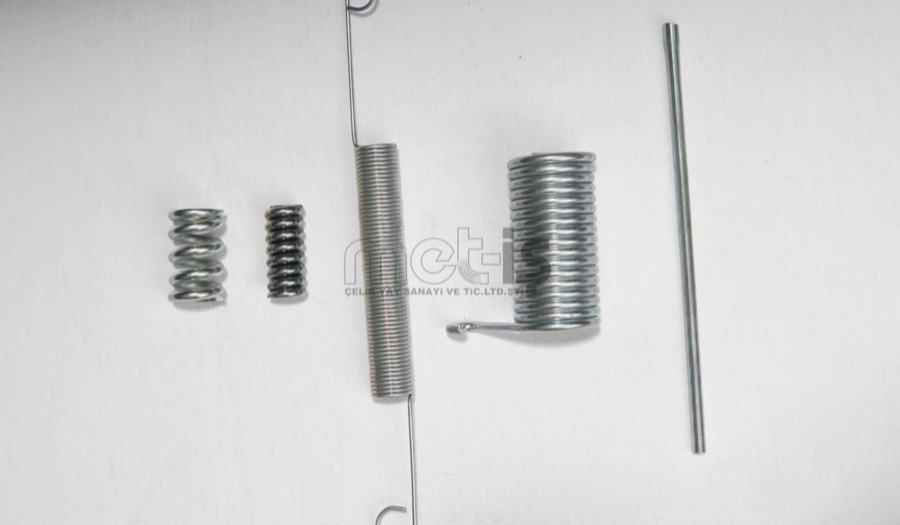
1. Working stress above the permissible level
This is the commonest cause. If a spring works at a stress higher than the material can carry, a little permanent deformation accumulates on every cycle. Free length shortens first and force drops; then a crack begins.
The symptom is characteristic: the spring loses its length before it breaks. For compression springs the calculator on our home page expresses this limit as a safety factor and shows the safe deflection limit.
2. Corrosion
Rust does damage in two ways. First, loss of cross-section: a thinner wire sees higher stress under the same load. Second and more dangerous, corrosion pits act as crack initiation sites — a fatigue crack almost always starts from a surface defect.
On springs working in contact with soil, moisture and agricultural chemicals, coating is therefore functional rather than cosmetic. Galvanised coating is standard in our production, and stainless material is considered where chemical exposure is high.
3. Loading in the wrong direction
On torsion springs coil direction is a rule, not a preference. The spring must be loaded in the direction it was wound; run the other way, the body diameter opens, the coils loosen on the shaft and life falls noticeably.
When a rake spring breaks early the cause is more often fitting it the wrong way round than the material. Confirming coil direction before assembly prevents these failures entirely.
4. Stress concentration at the root of the hook
On extension springs the whole load passes through the bend radius of the hook. A small radius means stress gathered into a narrow region, which is why the great majority of breakages happen at the hook rather than in the body.
The remedy is simple: where space allows, ask for a more generous bend radius. Of two extension springs with identical dimensions, the one with the wider hook radius lasts markedly longer.
5. Surface damage and notch effect
Fatigue cracks start at the surface. A spring left with plier marks, weld spatter, a grinding notch or rub marks from another spring during assembly therefore lasts far less than one that has been left untouched.
For the same reason springs should not be stored rubbing against one another, and the gripping point during assembly should be chosen on a part of the body that carries no load.
6. Heat treatment skipped or insufficient
Coiling leaves stress inside the wire. Tempering relieves that stress and makes the elastic property permanent. A spring coiled without stress relief loses length on its first loads; in heavy, thick-wire springs it takes a permanent set on the first heavy impact.
This is a step invisible on the production side that shows up directly as life in the field. Coiling, tempering, end grinding, galvanising and packing all happen in our own plant; none of it is outsourced.
7. Resonance and impact loading
In fast-running mechanisms, if the natural frequency of the spring approaches the driving frequency the coils begin to clash. The spring then sees stress far above its design load and breaks much sooner than expected.
The more common form on agricultural machinery is impact loading: the pickup tine strikes stubble on every revolution and the knotter makes a full stroke on every bale. In these groups it is fatigue life rather than static strength that governs.
What the broken part tells you
- Length lost before breakingOverstress — the working load is above the permissible level.
- Failure at the root of the hookStress concentration — the bend radius is too small.
- Rust and pitting on the surfaceCorrosion-driven fatigue; review the coating or the material choice.
- Body diameter opened outA torsion spring loaded in the wrong direction.
- A single origin point on the fracture faceSurface damage or a notch — possibly an assembly mark.
Frequently asked questions
If a spring breaks, is the material to blame?
Usually not. Most field failures come from working conditions — overstress, corrosion, wrong-way fitting or surface damage.
Why do extension springs always fail at the hook?
The whole load passes through the bend radius of the hook and stress concentrates there. Increasing the bend radius reduces that concentration.
How much does rust affect spring life?
Directly. Corrosion both removes cross-section and creates crack initiation sites; a fatigue crack almost always starts from a surface defect.
Is gripping a spring with pliers during assembly harmful?
If it leaves a mark on the load-carrying part of the body, yes. Because fatigue cracks start at the surface, plier marks, notches and rub marks shorten life noticeably.
Related pages
Cannot find the spring you need?
We produce to your dimensions in the 0.20–40 mm wire range, with no tooling dependency. A sample, a technical drawing, or simply a photograph of the old spring is enough.
Fill in the quote formOr call us directly: 0850 840 54 17