
What Is a Lynch Pin? Types and Choosing the Size
A lynch pin is the smallest part holding a connection together on farm machinery — and the one most often lost. When a pin drops in the field, work stops; that is why it is the first item a farmer keeps spares of. This article covers what the pin does, the names used for it in the field, the real difference between the types, and which dimension you need when ordering.
2026-09-124 min readMetiş Yay
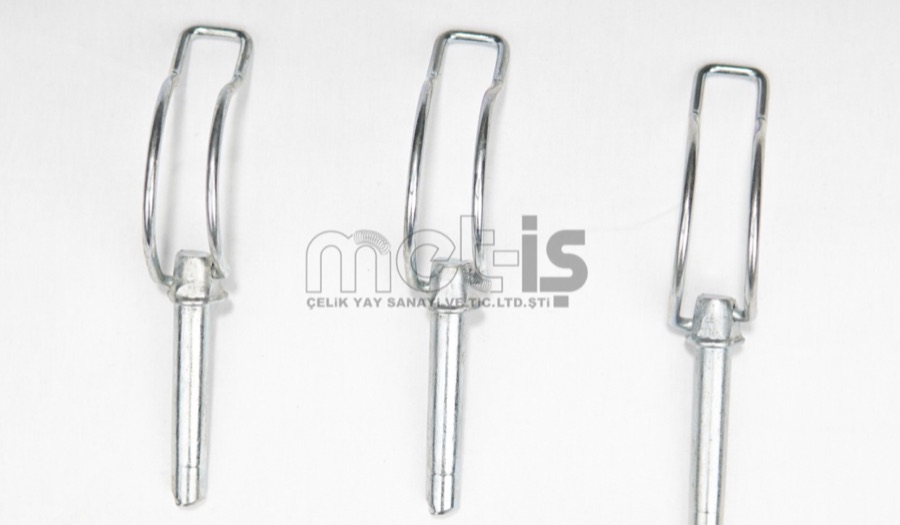
What a lynch pin does
A lynch pin carries no load; the shaft or bolt carries it. The pin's job is to stop that connection from working itself loose. In other words it is a safety element.
What does the work is not the body but the spring ring attached to it. The ring closes onto the pin and grips the shaft once it is through. When vibration pushes the pin out, the opening force of the ring holds it back. Once that force drops, the pin works its way out in the field — most lost pins do not fall out, they are pushed out.
It is used widely: PTO guards, drawbars and hitch pins, trailer couplings, seeding units, rake arms, seed drill units. Anywhere a fastening needs to open and close by hand without tools.
Types of lynch pin — and how they really differ
Several names are used interchangeably in the field, yet these are four different parts. Most of the confusion starts here.
The international reference for this family is DIN 11023, a standard titled simply “Agricultural machinery — Linch pins” and dated 1979. Foreign catalogues call the part a linch pin; in Turkish it is a lynch pin or a locking pin. You do not need the standard number to order — the dimensions are enough.
- Lynch pin (R ring) — a straight body with a spring ring riveted or welded to it. The ring closes onto the body. Our catalogue covers 4, 5, 6, 8 and 10 mm.
- R pin / hairpin clip — it has no body; the part itself is bent spring wire, named for its resemblance to the letter R. It goes straight through the hole. Our catalogue covers 3, 4 and 5 mm.
- D pin — a pin whose spring ring is D shaped. The wider ring opens in a single movement even with gloves on, so it is preferred where the pin is removed often. Our catalogue covers 6, 8 and 10 mm.
- Square pin — a body with a square section. Used where the connection must not rotate; a round pin turns in its seat, a square one does not. Our catalogue covers 8 mm.
- Split pin (cotter pin) — this is NOT a lynch pin. It is a two-legged, single-use part whose legs are bent open after fitting. A lynch pin is used again and again; a split pin is not. Using a split pin where the joint is opened often is the wrong choice.
Which dimension to ask for
Two dimensions decide a lynch pin; a third is rarely needed.
The first is body diameter. It is chosen to suit the hole, and it is the number in front of the pin name — "10 mm lynch pin" refers to the body thickness, not the length. Measure the hole with callipers; failing that, measure the body of the old pin.
The second is effective length: the part of the body from where the ring starts to the tip. This must be longer than the total thickness of the connection the pin passes through. Too short and the ring will not seat on the shaft, so the pin comes out at the first jolt. Too long does not stop it working, the tip simply protrudes.
If you cannot measure, the quickest route is a photo of the old pin next to a ruler; the quotation form accepts file attachments. Sizes outside the catalogue can also be produced — the coiling line works with no tooling dependency.
The pin sizes in our catalogue are listed below. The figure given is the body diameter — the thickness of the straight section that passes through the hole.
| Product | Body diameter | Item no |
|---|---|---|
| Lynch pin | 6 · 8 · 10 mm | 88 · 89 · 90 |
| D pin | 6 · 8 · 10 mm | 91 · 92 · 93 |
| Square pin | 8 mm | 94 |
Fitting, removing, and why pins go missing
A lynch pin needs no tools; that is the whole point of it. The body goes through the hole and the ring is pressed closed onto the shaft. Make sure the ring has fully caught the shaft — a half-seated ring looks fitted but does not hold.
To remove it, the ring is opened with a thumb and the pin pulled back. If the ring has stiffened or the coating has stuck, lifting it with a flat screwdriver is enough; no separate removal tool is needed. Forcing the ring with pliers permanently reduces its force — that pin will never hold again.
If a pin keeps going missing from the same place, the pin is usually not the culprit. The hole may have gone oval, the shaft may be worn, or the ring may be fatigued. A fatigued ring shows itself like this: when closed it does not touch the shaft, leaving a gap. Such a pin is replaced; trying to correct it does not work.
Galvanised coating is not a cosmetic choice on this part. Corrosion thins the section of the ring, and lost section directly reduces the opening force — so a rusted pin stops doing its job well before it breaks.
Frequently asked questions
What is a lynch pin?
It is a safety element that stops a connection from working itself loose. It consists of a straight body and a spring ring attached to it; the ring closes onto the shaft and holds the pin in place. It carries no load, it only secures.
What is the difference between a lynch pin and an R pin?
A lynch pin has a straight body with a separate spring ring attached. An R pin has no body; the part itself is spring wire bent into an R and it passes straight through the hole. Lynch pins suit thicker connections, R pins thinner ones that are opened often.
Is a split pin the same as a lynch pin?
No. A split pin is a two-legged, single-use part whose legs are bent open after fitting. A lynch pin opens and closes by hand and is used many times over. On a joint that is opened often, a split pin means fitting a new one every time.
What sizes do you produce?
The catalogue covers lynch pins in 6, 8 and 10 mm; D pins in 6, 8 and 10 mm; square pins in 8 mm; hairpin clips in 3, 4 and 5 mm. Sizes outside these can be produced from a sample or from dimensions.
How do I work out the size?
Body diameter is chosen to suit the hole, and effective length must be longer than the total thickness of the connection. If you have no callipers, a photo of the old pin next to a ruler is enough for most items.
The pin keeps coming out — what should I do?
Look at the ring first: if it does not touch the shaft when closed, the spring is fatigued and the pin should be replaced. If the ring is sound, the hole may have gone oval or the shaft may be worn. Squeezing the ring with pliers is not a lasting fix and reduces its force further.
Do I need a special tool to remove one?
No. The ring opens with a thumb or a flat screwdriver. No separate removal tool is needed; opening and closing without tools is the whole reason this part exists.
Can I order a set of mixed sizes?
Yes, different sizes are packed separately. Just state how many of each size you need on the order line.
Related pages
Cannot find the spring you need?
We produce to your dimensions in the 0.20–40 mm wire range, with no tooling dependency. A sample, a technical drawing, or simply a photograph of the old spring is enough.
Fill in the quote formOr call us directly: 0850 840 54 17