
When Should Baler Springs Be Replaced?
Spring failure on a baler rarely arrives without warning. Almost always performance falls first and the part breaks later. Knowing how to read that window is the difference between a machine stopped mid-harvest and a half-hour check before the season starts.
2026-09-123 min readMetiş Yay
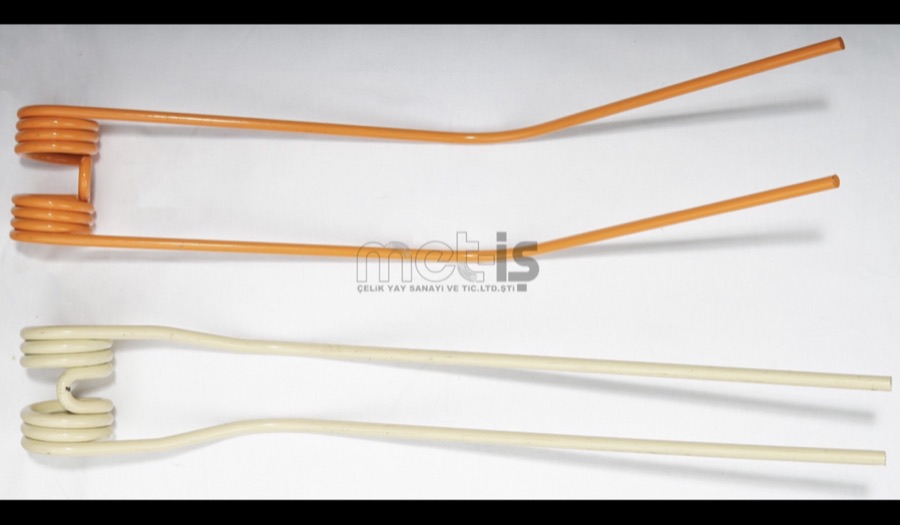
Measure first: free length is the most honest indicator
A fatigued spring loses its length before it breaks. On compression and extension springs, if the free length — measured end to end with no load — has shortened against the original, the spring is no longer giving its old force. That change is invisible to the eye yet directly upsets the setting of the mechanism.
If no new spring is available for comparison, equivalent springs on the same machine can be measured against each other. Where springs working in the same group differ noticeably in length, the shorter ones have fatigued.
On torsion and tine springs, look at the angle rather than the length
Pickup tines and rake springs are torsion type; in these, fatigue shows not as lost length but as a permanent opening of the leg angle. After a while the spring no longer returns to its original angle even unloaded.
The field symptom is clear: the tine no longer takes a full bite, skipping begins and pickup performance drops. At that point the spring is still intact but it is not doing its job.
Five signs that decide the replacement
Any one of these signs is enough on its own. Where two appear together, replacement should not be postponed.
- Free length has shortenedA measurable reduction against the original means the spring has lost force.
- Leg angle has openedOn torsion and tine springs this is the first and most visible sign of fatigue.
- Wear has started at the tipThinning at the tine tip means lost cross-section, and breakage starts there.
- Corrosion on the surfaceRust reduces cross-section, lowers spring force and creates crack initiation points.
- Bale density has droppedWhen the spring in the pad pressure group fatigues, bales come out loose; if adjustment does not fix it, check the spring.
One at a time, or the whole row?
Springs working in the same group see similar loads over a similar number of cycles, so they fatigue at a similar rate. If one has broken, its neighbours are near the end of their life too.
Replacing a whole row gains two things: the machine works evenly and you avoid one failure after another in the field. This is common practice in pickup and rake groups. Single-part sales are also available; the decision follows how hard the machine is worked.
The half-hour pre-season check
Because the harvest window is narrow, this check belongs before the season rather than in the field. Scan the leg angles along the pickup row by eye, feel the tips for wear, and compare the free lengths of the springs in the pad pressure group.
Keeping spares for the items you find suspect is always cheaper than standing still mid-harvest. The baler springs in our catalogue are made to original dimensions; the make and model of the machine is enough to identify most items.
Frequently asked questions
The spring has not broken but pickup performance has dropped — should I replace it?
Yes. On torsion type pickup and rake springs, fatigue appears as opening before it appears as breakage; the spring can look sound while no longer doing its job.
How much loss of free length calls for replacement?
Any measurable reduction against the original means the spring has lost force. Where no new spring is available, compare the measurement against other springs in the same group.
Why replace springs a row at a time?
Springs in the same group see similar loads over a similar number of cycles and fatigue at a similar rate. If one has broken, its neighbours are close behind.
Can parts be identified without an original part number?
Yes. The make and model of the machine plus the name of the part is enough for most items; where there is doubt, a photograph of the old spring next to a ruler settles it.
Related pages
Cannot find the spring you need?
We produce to your dimensions in the 0.20–40 mm wire range, with no tooling dependency. A sample, a technical drawing, or simply a photograph of the old spring is enough.
Fill in the quote formOr call us directly: 0850 840 54 17