
Torsion and Wire Form Springs
Torsion springs that transmit a moment through their legs, together with wire form parts. This is the most widely used spring family in hay rake, tine and baler groups.
How torsion and wire form springs work
A torsion spring is loaded not along its axis but about it: the body coil twists and the legs rotate relative to one another. The consequence for calculation is clear — here the wire is not twisted but bent. The modulus of elasticity is therefore used instead of the shear modulus, and the moment rate is found from k = E·d⁴ / (3667·Dm·n). The result is a moment rather than a force, which our calculator reports in N·mm per degree.
Coil direction is not a preference in a torsion spring but a rule. The spring must be loaded in the direction it was wound; run the other way, the body diameter opens, the coils loosen on the shaft and life falls noticeably. When a rake tine spring breaks early in the field the cause is more often fitting it the wrong way round than the material.
The second decisive factor is leg length. Two different legs on the same body mean two different springs: as the leg gets longer the moment needed for the same angle drops, so the spring becomes softer. Leg length and leg angle are therefore as important as wire diameter when ordering a torsion spring.
In this family, field failure is usually not breakage but opening. As the leg angle widens the tine no longer takes a full bite of the crop and skipping begins. That is the sign the material has reached its fatigue limit; replacing a whole row rather than single springs keeps the machine working evenly.
The most sought-after item in this family is the tine spring of a gearbox-driven rotary rake, where the arms rotate continuously and the tines see far more cycles than on a trailed rake. Every torsion spring rule applies there too: coil direction, leg length, leg angle.
The same production family also covers wire form parts: swallowtail and U-form springs, swing springs, hairpin clips and R clips. In these the body coil shrinks and the form and leg geometry become decisive. Because we work without tooling dependency, such parts can be produced from a sample or a technical drawing.
Leg forms
The quotation table asks for leg length, leg angle and winding direction separately. The reason: two different legs on the same body are, in practice, two different springs. The leg forms are:
- Straight leg — the most common form. The leg leaves the body tangentially and the tip is left unworked.
- Axial leg — the leg runs along the body axis. Used in mechanisms that sit on a shaft.
- Radial leg — the leg leaves perpendicular to the body diameter; preferred in short-arm mechanisms.
- Looped or bent tip — the leg tip is bent into a loop or hook and slips over a pin or rod.
- Winding direction — right or left hand. If not stated on the order it is read from the sample; where there is no sample we always ask.
Material and standard
In a torsion spring the wire does not twist, it bends, so the bending strength of the material is what counts. Two wire families are used in production, each defined by its own European standard.
- Carbon spring steel wire — EN 10270-1. Known in the field as Ck67, Ck75, C60 and C70. Galvanised standard agricultural and machine items come from this family.
- Stainless spring wire — EN 10270-3. 1.4310, AISI 302 and 304 are different designations of the same family.
- Wire diameter range — the coiling line works between 0.20 mm and 40 mm.
- Class code — the SL, SM, SH, DM or DH code on the wire certificate marks the tensile strength band. Set out in the spring steel guide.
Dimensions we need for a quotation
Body dimensions alone are not enough on a torsion spring — the leg geometry directly determines its stiffness.
| Dimension | What it means |
|---|---|
| Wire diameter · d | The diameter of the wire the spring is coiled from. |
| Body inside / outside diameter | If the spring seats on a shaft, the inside diameter is the governing dimension. |
| Coil count · n | The number of coils in the body. |
| Leg length | For each leg separately. The longer the leg, the softer the spring. |
| Leg angle · θ | The angle between the two legs in the unloaded state. |
| Coil direction | Right or left hand. The spring must be loaded in the direction it was wound. |
Torsion and Wire Form Springs calculator
Enter your dimensions and we will return the spring rate, solid length and spring index instantly — with a warning if the index leaves the healthy band.
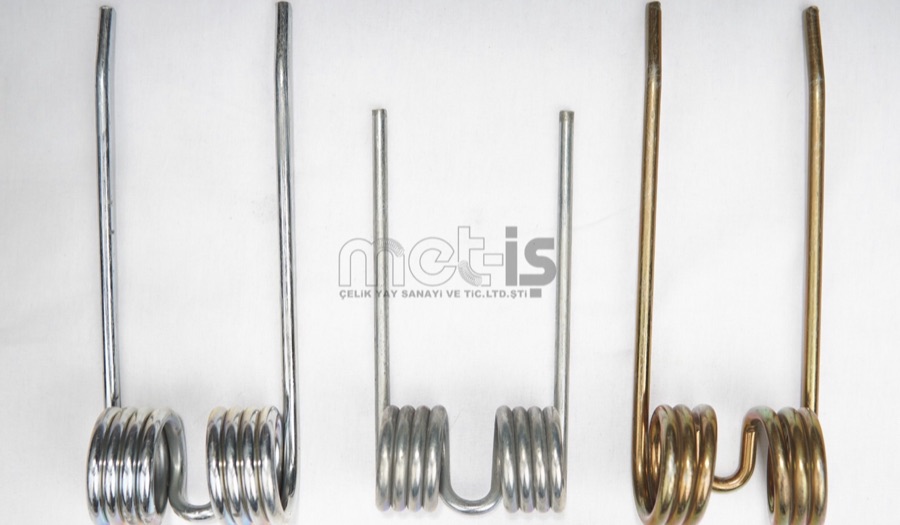
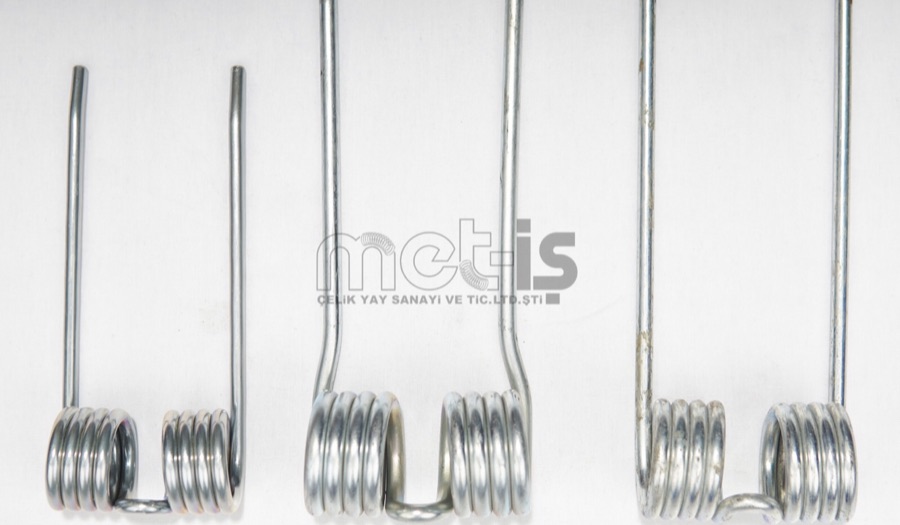
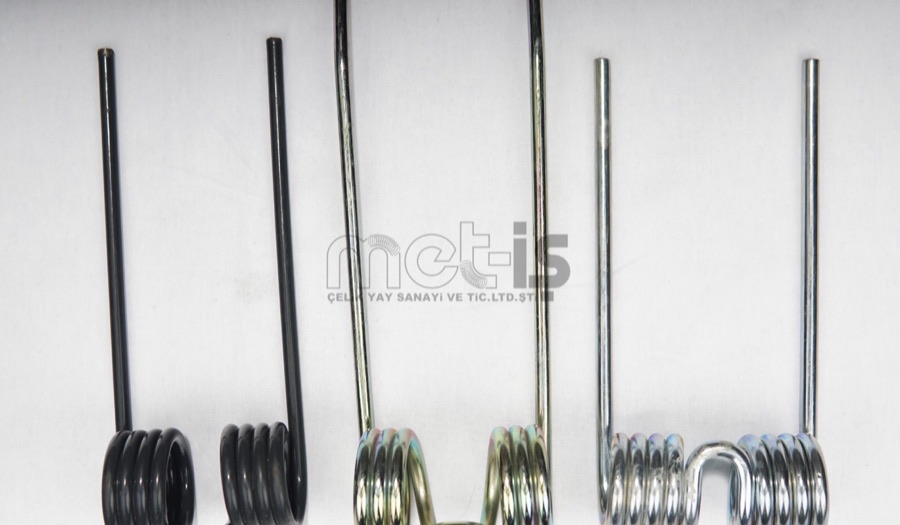
Photographs from production
Which machine groups use it
Springs of this type appear in the following groups in our catalogue, each listed in detail on its own page.
How it is made
Every step after coiling happens in our own plant; nothing is outsourced. This shortens lead times and keeps quality responsibility in one pair of hands.
CNC coiling
Formed across the 0.20–40 mm wire range.
Tempering
Stress is relieved; elasticity becomes permanent.
End grinding
Seating faces are flattened on compression springs.
Galvanising
Surface protection against corrosion.
Packing
Domestic and export logistics included.
Frequently asked questions
Why is the modulus of elasticity used for torsion springs?
Because the wire bends rather than twists. In compression and extension springs the load becomes shear stress in the cross-section and the shear modulus applies; in a torsion spring bending governs, so the modulus of elasticity is used.
What happens if I fit the spring the wrong way round?
The body diameter opens, the coils loosen on the shaft and life falls noticeably. A torsion spring must always be loaded in the direction it was wound.
Does leg length affect stiffness?
Directly. As the leg gets longer the moment needed for the same angle drops, so the spring becomes softer. Two different legs on the same body mean two different springs.
Why do hay rake springs open out instead of breaking?
In a torsion spring fatigue first shows as permanent opening. As the leg angle widens the tine no longer takes a full bite of the crop — the sign that the material has reached its fatigue limit.
Can you produce a leg angle different from the original?
Yes. On form springs the leg angle is a production parameter and can be made to the angle you need.
Do hairpin clips and R clips belong to this group?
Yes. Wire form parts are handled in the same production family, and because we work without tooling dependency they are made from a sample or a technical drawing.
Other spring types
Cannot find the spring you need?
We produce to your dimensions in the 0.20–40 mm wire range, with no tooling dependency. A sample, a technical drawing, or simply a photograph of the old spring is enough.
Fill in the quote formOr call us directly: 0850 840 54 17