
How to Measure a Compression Spring
You do not need a catalogue number to have a broken spring reproduced. Five dimensions and a caliper are enough. This article covers each of them, how to take them, and where it is easy to go wrong.
2026-09-123 min readMetiş Yay
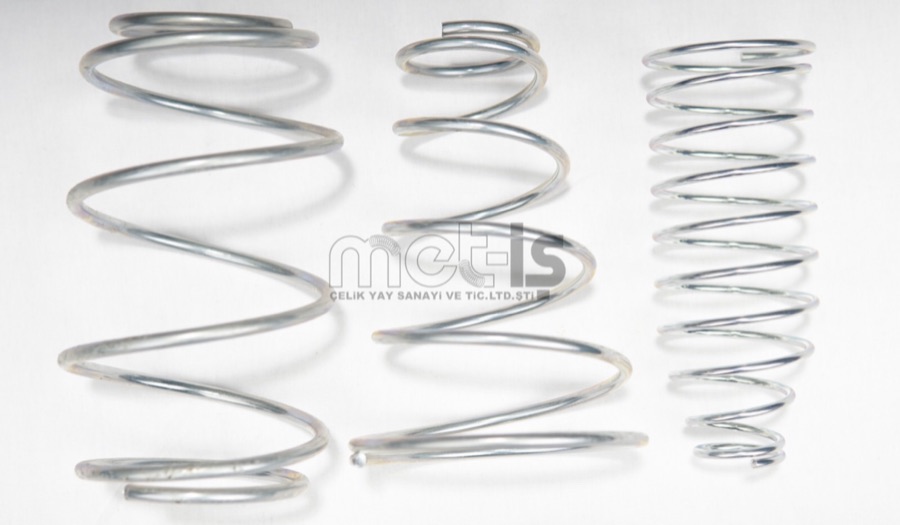
Before measuring: be sure which spring you are holding
If there is a gap between the coils and the spring works by being compressed, it is a compression spring. If the coils are closed and there are hooks at the ends, it is an extension spring. If the diameter changes from one end to the other it is a conical spring, and both ends must be measured.
The distinction matters because each type needs a different set of dimensions. The steps below are for a straight cylindrical compression spring.
1. Wire diameter · d
Measure the thickness of the wire itself with a caliper. This is the dimension that affects the result most: spring rate varies with the fourth power of wire diameter, so a ten per cent error means roughly a forty-six per cent error in stiffness.
Take the measurement from a sound coil in the middle of the spring. The end coils may have been ground, leaving a reduced wire section there.
2. Outside diameter · Dd
The outer measurement of the coil, taken with the outer jaws of the caliper. This is the figure chosen to suit the bore.
The mean diameter used in calculation is derived from it: Dm = Dd − d. There is no need to measure it separately.
3. Free length · L₀
The end-to-end length with no load on the spring. Standing it on a flat surface and measuring with a rule is enough.
Take care: if the spring in your hand has fatigued, its free length has already shortened. A new spring made to that figure copies the fatigued state rather than the original. Measure an unused example if you can; if not, say so when ordering.
4. Active coil count · n
The number of load-carrying coils. On a closed-end spring, subtract two from the total coil count — the end coils carry no load and serve to seat the spring.
To count, turn the spring on its side, start at one end and count full turns. Half turns count too: a value such as 8.5 is normal and is used in the calculation.
5. End form and coil direction
There are three end forms: closed and ground, closed but unground, and open. Stand the spring upright on a flat table — if it stands square and steady, the end is closed and ground.
For coil direction, look at the spring from the side: if the coils rise from left to right it is right hand, otherwise left hand. On a spring working alone this often makes no difference; on nested pairs the two springs are wound in opposite directions and the information is required.
At a glance: the measurement sheet
All five dimensions, where each is taken from, and the mistake made most often with it. Filling in these rows is enough to place an order; where a dimension cannot be taken, a photograph with a rule laid beside the spring also does the job.
| Dimension | Symbol | Where and with what | Commonest mistake |
|---|---|---|---|
| Wire diameter | d | From a sound coil in the middle, with a caliper | Measuring at a ground end — the wire section is reduced there |
| Outside diameter | Dd | Across the outside of the coil, outer caliper jaws | Mistaking the inside diameter for it; the difference is two wire diameters |
| Free length | L₀ | On a flat surface, unloaded, with a rule | Measuring a fatigued spring — its free length has already shortened |
| Active coils | n | Turn it on its side and count full turns; half turns count too | Giving total coils on a closed-end spring — active is two fewer |
| End form | — | Stand it upright on a table: square and steady means closed and ground | Not stating the end form when ordering |
| Hand of wind | — | Look from the side: coils rising left to right is right hand | Omitting it on nested spring pairs |
The three commonest mistakes
- Measuring wire diameter at a ground endThe section may be reduced at the end coils; take the measurement from a sound coil in the middle.
- Mistaking inside diameter for outside diameterThe calculation is built on outside diameter; if you give the inside diameter, state that clearly.
- Copying the free length of a fatigued springThe shortened length is not the original; a new spring made to it will give too little force.
Once you have the dimensions
With these five values you can enter them into the calculator on our home page and see the spring rate, solid length and spring index. If the index falls outside the 4–12 band the calculator warns you — a chance to correct the dimensions before production.
Where you cannot take measurements, a photograph of the old spring next to a ruler is enough for most items. You can send it through the quote form.
Frequently asked questions
I have no caliper — can I measure with a rule?
A rule works for free length and outside diameter. Wire diameter needs a caliper; it is the value that affects the result most and should never be estimated by eye.
How do I count the active coils?
On a closed-end spring, subtract two from the total coil count; the end coils carry no load. Half turns count too, so values such as 8.5 are normal.
Should I give inside or outside diameter?
The calculation is built on outside diameter. If you give the inside diameter, state it clearly; the difference between them is two wire diameters.
Does measuring a fatigued spring give the right result?
Not for free length — a fatigued spring has already shortened. Measure an unused example if possible; otherwise note the situation when ordering.
Related pages
Cannot find the spring you need?
We produce to your dimensions in the 0.20–40 mm wire range, with no tooling dependency. A sample, a technical drawing, or simply a photograph of the old spring is enough.
Fill in the quote formOr call us directly: 0850 840 54 17