
Compression Springs
Cylindrical coil springs that work under axial compressive load. We manufacture them to original dimensions across the 0.20–40 mm wire range, with closed and ground end options and galvanised finish.
How compression springs work
A compression spring is coiled with a gap between its turns and produces a counter force when compressed along its axis. Despite appearances the wire does not bend, it twists — the whole load turns into shear stress in the cross-section. This is why the shear modulus is used and the spring rate is found from k = G·d⁴ / (8·Dm³·n).
The fourth power in that relation is the detail that misleads most often in the field: enlarging the wire diameter by only ten per cent stiffens the spring by roughly forty-six per cent. Changes made on the idea of "the same spring, slightly thicker wire" therefore give a far stiffer spring than expected and strain the mechanism.
Five dimensions define a compression spring: wire diameter, outside diameter, free length, number of active coils and end form. The first four set the force; the fifth sets how the spring seats. A closed and ground end seats the spring square to the surface and centres the load, while an unground end lets it lean under load. Solid length — the length the spring takes when fully compressed — is about (n+2)·d on a closed-end spring, and if the installation gap falls below that value the spring is permanently crushed.
The best indicator of manufacturability is the spring index: the ratio of mean diameter to wire diameter, C = Dm/d. Below four the wire is overstrained during coiling; above twelve coiling becomes unstable and the spring tends to buckle. The calculator on our home page warns you when your figures fall outside this band, so you can correct the dimensions on screen without waiting for a quotation.
Failure in a compression spring usually begins not with breakage but with a loss of free length. A spring working above the permissible shear stress settles a little on every cycle; its force drops and the mechanism loses its setting. The safety factor therefore answers not only "will it break" but also "for how many seasons will it give the same force". If tempering after coiling is skipped, that same settling happens on the very first load.
Types of compression spring
A compression spring is not a single product but a family. The distinctions are made on three axes: the geometry of the coil, the material of the wire and the place the spring works. The list below gathers those three axes together with what each corresponds to in our own production.
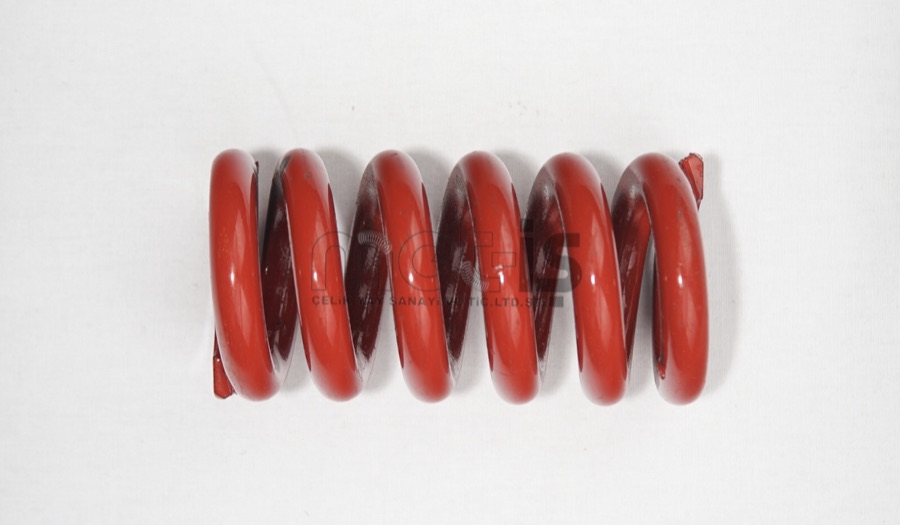
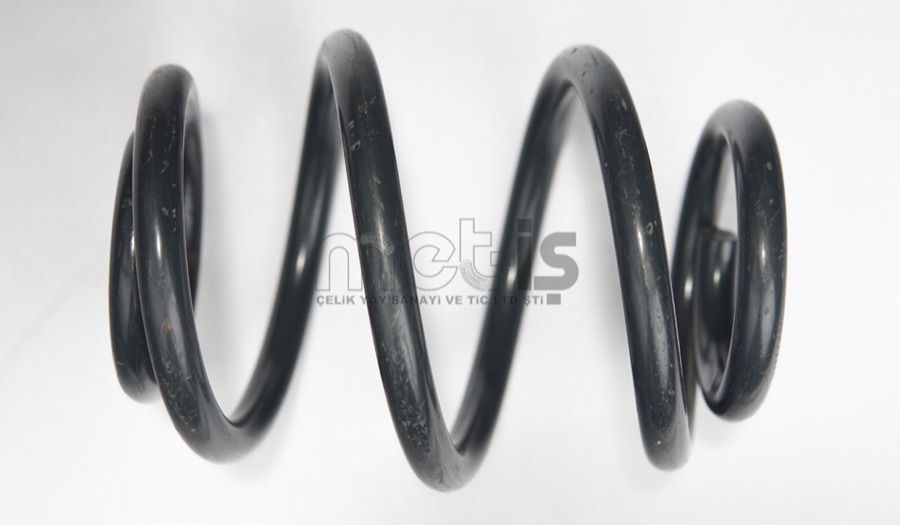
- Cylindrical (helical) compression spring — the most common form. Its diameter is constant along its length and the force rises linearly along the stroke. This is what is meant when only "compression spring" is said.
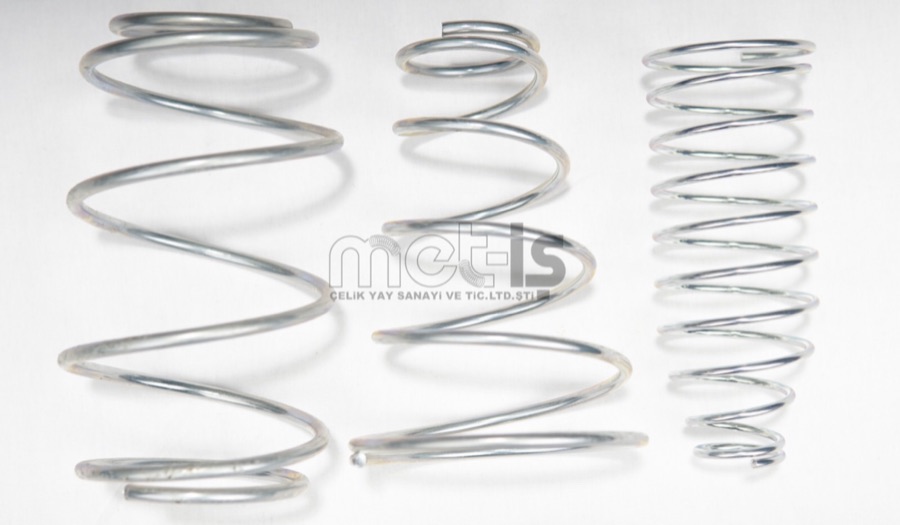
- Conical compression spring — a coil that narrows along its length. Because the coils nest inside one another when closed it takes up little space and resists lateral buckling. It has a page of its own: conical springs.
- Stainless compression spring — made from stainless wire for environments open to corrosion. In food, spraying and damp-environment applications the material itself is the answer rather than a coating.
- Galvanised steel compression spring — the standard agricultural and machine item, coiled from spring carbon steel and galvanised. The coating is not cosmetic here; corrosion lowers spring force through loss of cross-section.
- Small and long compression springs — our coiling line works from 0.20 mm to 40 mm wire diameter. That range reaches from millimetric springs inside a mechanism to heavy duty springs on a cultivator leg.
- Pad pressure spring — the group that sets chamber density on a baler. Our catalogue carries it as three separate items: upper pad, cradle pad and shear pad.
- Seed drill compression spring — works in the press group that holds sowing depth constant. Separate items are listed by brand in the seed drill category.
What makes a compression spring cylindrical
A cylindrical compression spring is one whose coil diameter stays the same from one end to the other. That single geometric fact is what decides its behaviour: because the mean diameter does not change along the body, every active coil carries the same share of the load, and the force rises in a straight line with the stroke. A cylindrical spring compressed twice as far pushes back roughly twice as hard.
The contrast is the conical spring, whose diameter narrows along its length. There the coils nest inside one another as the spring closes, so the solid length drops towards a single wire thickness and the force curve bends upward instead of running straight. Neither form is better in the abstract — a cylindrical spring is chosen where a predictable, linear rate matters and where there is room for the solid length; a conical one where the closed height has to be short.
Cylindrical is the form the great majority of our catalogue carries, and it is what the calculator on the home page assumes: the rate k = G·d⁴ / (8·Dm³·n) holds for a constant mean diameter. We coil this form across the whole 0.20–40 mm wire range, with closed and ground or closed and unground ends, and galvanised as standard.
Compression spring dimensions — why there is no ready-made table
What someone looking for a compression spring most often wants is a dimension table or a catalogue number. We do not publish one, and the reason is technical rather than commercial: the dimensions of a compression spring mean nothing on their own. Two springs with the same outside diameter and free length will give opposing forces if their wire diameter and coil count differ. Copying the dimensions and missing the force is the most common mistake made when ordering springs.
The correct route is the reverse: the force and stroke the mechanism needs are established first, and the dimensions are derived from them. If you have a working sample the job is easy — five dimensions (wire diameter, outside diameter, free length, active coils, end form) are taken and the spring is reproduced exactly. Without a sample, the calculator on our home page carries out that derivation on screen.
This is why our catalogue is a list of machine groups rather than dimensions: it is arranged by which spring works in which group of which machine. If the spring you are looking for sits on an agricultural machine, finding it through the category pages gives a faster answer than guessing dimensions.
Ordering a compression spring and what changes the price
We do not publish a price list, because there is no single unit price for a compression spring — the same spring costs many times more or less depending on quantity and the number of operations. Price is set by wire diameter and material grade (carbon steel or stainless), the weight of the spring, quantity, whether the ends are ground, the type of coating and any special packing.
The most decisive of these is quantity. A single replacement part and a series production run for a machinery manufacturer come off the same line but not at the same price; setting up the coiling is a fixed labour cost that is divided by the quantity. Stating quantity when you ask for a quotation is therefore the way to get the fastest and most accurate price.
An order can start from any of three things: a sample, a technical drawing or dimensions. Because we work without tooling dependency you do not need to commission tooling for a spring that is not on the list. If you cannot measure, a photograph of the old part next to a ruler is enough for most items; the quote form accepts file attachments.
Material and standard
In a compression spring the material comes before the dimensions: the same geometry coiled from a different wire gives a different force and a different service life. Two wire families are used in production — carbon spring steel and stainless spring wire. Both are defined by their own European standard.
On the wire certificate a two-letter class code sits next to the material name: SL, SM, SH, DM or DH. This code marks the tensile strength band of the wire and directly sets the stress the spring can carry. What the codes mean, and how diameter relates to strength, is set out in detail in the spring steel guide.
- Carbon spring steel wire — EN 10270-1. Known in the field as Ck67, Ck75, C60 and C70. Every galvanised standard agricultural and machine item comes from this family.
- Stainless spring wire — EN 10270-3. 1.4310, AISI 302 and 304 are different designations of the same family. In damp environments, food handling and crop spraying the material itself is the answer rather than a coating.
- Wire diameter range — the coiling line works between 0.20 mm and 40 mm. The lower end covers millimetric springs inside a mechanism, the upper end the heavy-duty springs on a cultivator leg.
- Material certificate — the wire used arrives with a mill certificate under EN 10204. Certificate images are on the certifications page.
- Management system — production runs under an eight-certificate system including ISO 9001:2015 and IATF 16949.
End types
The two ends of a compression spring decide how it seats and how evenly it transfers load. Changing the end form changes the number of active coils and therefore the spring rate — which is why it is asked as a separate field on the quotation form.
- Closed and ground — the last coil is laid against the body and the end face is ground flat. It transfers load most evenly and resists buckling best; preferred in precision mechanisms.
- Closed, not ground — the last coil is laid down but no grinding is done. The most common form on agricultural and general machine items; it seats well enough without the cost of grinding.
- Open, not ground — the coil pitch is kept at the ends as well. The most economical form, but the spring does not seat perfectly flat; used in lightly loaded, free-running positions.
- Open and ground — an uncommon form; the end is left open and only the surface is ground. Used on long, slender springs to correct seating.
Dimensions we need for a quotation
If you have the values below, no sample is required. Anything missing can be filled in with a photograph of the old spring taken next to a ruler.
| Dimension | What it means |
|---|---|
| Wire diameter · d | The diameter of the wire the spring is coiled from. The most influential dimension; it enters the relation to the fourth power. |
| Outside diameter · Dd | The outer measurement of the coil, chosen to suit the bore. Mean diameter Dm = Dd − d. |
| Free length · L₀ | End-to-end length of the spring with no load applied. |
| Active coils · n | The number of load-carrying coils. On a closed-end spring this is the total coil count minus two. |
| End form | Closed and ground, closed unground, or open end. This determines how the spring seats. |
| Coil direction | Right or left hand. Nested spring pairs are wound in opposite directions. |
Compression Springs calculator
Enter your dimensions and we will return the spring rate, solid length and spring index instantly — with a warning if the index leaves the healthy band.
Photographs from production
Which machine groups use it
Springs of this type appear in the following groups in our catalogue, each listed in detail on its own page.
How it is made
Every step after coiling happens in our own plant; nothing is outsourced. This shortens lead times and keeps quality responsibility in one pair of hands.
CNC coiling
Formed across the 0.20–40 mm wire range.
Tempering
Stress is relieved; elasticity becomes permanent.
End grinding
Seating faces are flattened on compression springs.
Galvanising
Surface protection against corrosion.
Packing
Domestic and export logistics included.
Frequently asked questions
What is the difference between a compression and an extension spring?
A compression spring works by being pushed together, an extension spring by being pulled apart. A compression spring has a gap between its coils and its ends are usually ground; an extension spring has closed coils and a hook at each end. The spring rate relation is the same for both.
How is solid length calculated?
On a closed-end compression spring it is about (n+2)·d: the end coils are added to the active coils and the total is multiplied by the wire diameter. If the installation gap falls below this figure the spring closes solid and is permanently crushed.
How much stiffer does the spring get if I increase the wire diameter?
The spring rate varies with the fourth power of wire diameter. A ten per cent larger wire makes the spring roughly forty-six per cent stiffer. Wire diameter is therefore the last adjustment to reach for; coil count and diameter are considered first.
Why does the spring index matter?
The spring index C = Dm/d indicates manufacturability. Below four the wire is overstrained during coiling; above twelve coiling becomes unstable. The healthy band is 4–12, and the calculator warns you when you leave it.
Is end grinding necessary?
If the spring must seat square on a flat surface and centre the load, yes. An unground end lets the spring lean under load. End grinding is carried out in our own plant.
I have no sample — can you produce from dimensions alone?
Yes. Given wire diameter, outside diameter, free length, active coil count and end form, no sample is needed. Sending these values through the quote form is enough.
What types of compression spring are there?
By geometry, helical (cylindrical) and conical; by material, spring carbon steel and stainless; by finish, galvanised and painted. On the agricultural side they are also named after the group they work in, such as pad pressure springs and seed drill springs. All are produced from the same calculation; what differs is the working condition.
Is a cylindrical spring the same as a compression spring?
In everyday use, yes: "cylindrical spring" almost always means a cylindrical compression spring, the form whose coil diameter stays constant end to end. It is the most common compression spring form and the one most of our catalogue carries. The distinction only matters against the conical form, where the diameter narrows and the coils nest when closed.
Do you make stainless compression springs?
Yes. In environments open to corrosion the stainless wire itself is used instead of a coating; it is preferred on sprayers, in damp environments and in applications with food contact. Material is chosen according to where the spring will work.
What determines the price of a compression spring?
Wire diameter, material grade, the weight of the spring, quantity, end grinding, coating type and packing. Quantity is the most decisive of these: setting up the coiling is a fixed labour cost divided by the quantity. Stating quantity with your enquiry is the way to get the most accurate price.
Do you have a catalogue of standard compression spring sizes?
Our catalogue lists machine groups rather than dimensions — it is arranged by which spring works in which group of which machine. The reason is technical: two springs with the same outside diameter and free length give opposing forces if wire diameter and coil count differ. Copying dimensions and missing the force is the most common ordering mistake.
Do you have a compression spring calculator?
The spring calculator on our home page works out the spring rate, working length, solid length and Wahl-corrected safety factor for compression springs; it warns when the spring index leaves the healthy band and draws a technical drawing sheet. It needs no installation and runs in the browser.
Related pages
Other spring types
Cannot find the spring you need?
We produce to your dimensions in the 0.20–40 mm wire range, with no tooling dependency. A sample, a technical drawing, or simply a photograph of the old spring is enough.
Fill in the quote formOr call us directly: 0850 840 54 17