
Rake Spring Types and Their Field Names
The greatest waste of time when looking for a spare part is finding that what you need is sold under a name other than the one you know. The rake spring is the extreme case: the same product is called a rake spring, a tine, a pickup spring or a windrow spring depending on the region and the seller. And one of those names — the rake plate — is not a spring at all. This article sets out what each name describes and which one works on which machine.
2026-09-126 min readMetiş Yay
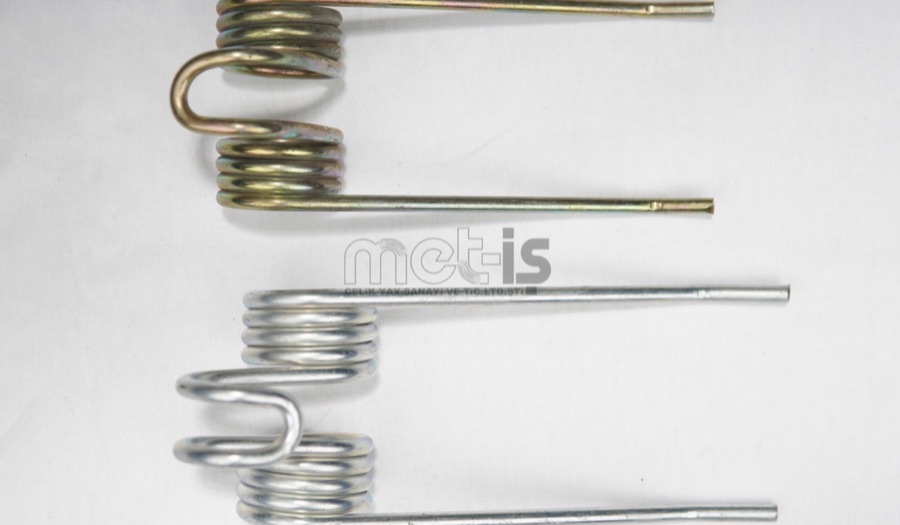
Five names, two families of parts
What looks like a crowd of names in fact divides into two families: the springs in the pickup group of a baler, and the springs on the rotating arm of a gearbox-driven rotary rake. Both are torsion type form springs and both lift the crop off the ground — but their dimensions, leg forms and working loads are different.
The list below separates which name belongs to which family. It does not matter which word you use when ordering; what governs is which machine the part is on and where it sits.
- Rake spring — the broadest name, used for both the baler pickup spring and the rake arm spring. Not enough on its own; the machine name is needed alongside it.
- Tine — the same part, common on the baler side. The word refers to the straight leg rather than the coiled body.
- Pickup spring — the group that moves crop from the ground into the feed channel on a baler.
- Windrow spring — the name used on the rotary rake side. A windrow is mown crop gathered into a row; the spring sits at the end of the arm that forms it.
- Helicopter spring — again the rake side. A gearbox-driven rotating-arm rake is called a helicopter in Turkish field usage.
- Rake plate — not a spring. It is the sheet part the spring mounts to and is sold separately; our catalogue lists it as the hay rake spring plate. If the plate is cracked when you renew the spring it should be replaced too — a cracked plate holds the spring at the wrong angle and the new spring opens quickly.
The baler pickup spring
On a baler, the pickup group lifts crop or straw off the ground and feeds it into the channel. The tine touches stubble on every revolution, making this the highest-cycle position on the machine. What governs is fatigue life rather than static strength.
Within this family springs divide into short and long versions by body length; our catalogue carries the New Holland pickup spring as two separate items, short and long, with separate items for Krone, Mascar, Hammer and John Deere. Fitting the wrong leg length while the body dimension matches is a common mistake: the longer the leg, the lower the moment needed for the same angle, so the spring softens and opens faster than expected.
Two further items work in the same group: the 6 mm rake ratchet pressure spring holds the pickup flow arrangement, and the rake cartridge spring works at the tine mounting. Neither substitutes for the pickup spring.
The rotary rake (helicopter) spring
On a gearbox-driven rotary rake the spring sits at the end of the rotating arm and gathers the crop into a row — a windrow. It differs from the baler pickup spring in two ways: the legs are longer, and because contact with the field surface is more direct, the impact loading is heavier.
The distinguishing form in this family is the double-legged spring. The body coil takes the load in torsion and the two legs transfer it to the arm at two points, balancing the moment and stopping the leg from wandering sideways. The cost is this: if the angles of the two legs drift apart, the load piles onto one leg and that side fatigues quickly. Each leg angle should be checked separately on a spring that has been removed.
Our catalogue lists this group by brand: Çelmak, Fimaks, Hisarlar, Harmak, Karataş, Akyollar, Azimli, Metkarsan, Yurdusar, Krone, Massey Ferguson, Pöttinger, Gallignani, Gaspardo and Paksan types are all separate items.
Trailed rakes
Two further rake types are mentioned alongside the gearbox-driven type. One is the trailed rake with spring tines arranged in rows one behind another. The other works with finger groups arranged in a circle and takes its Turkish name from that daisy-like appearance.
All three do the same job: turning mown crop into a windrow. The difference on the spring side is the working load — on the gearbox-driven type the arm is power-driven, so the spring sees both a higher cycle count and a more regular load; on trailed types the load is more irregular but generally lower.
That distinction matters when looking for spares, because one manufacturer may build several rake types. Stating whether your rake is gearbox-driven or trailed makes the match certain.
How to tell when to replace
Failure in rake springs begins with opening rather than breakage. The order is usually this: the leg angle widens, the tip no longer takes a full bite, raking performance falls and the windrow stays ragged; then a fatigue crack starts at the bend where the body meets the leg; breakage comes last. In other words the spring stops doing its job long before it breaks.
- Leg angleRelease the removed spring and set it alongside a new one. If the angle is noticeably wider, the spring has reached the end of its life.
- Symmetry on double legsCompare each leg angle separately. If they have drifted apart, the load is piling onto one leg.
- The bend regionLook where the body meets the leg. A fine line on the surface is a fatigue crack; the spring is about to break.
- Plate and mountingIf the rake plate is cracked or the hole has gone oval, a new spring will seat at the wrong angle and open quickly. Check the plate as well.
- Look at the setSprings on the same arm or row see similar loads over similar cycles. If one has broken, its neighbours are at the end of their life too.
What to state when ordering
The brand name is a good start but not enough on its own, because one manufacturer uses different springs on different machine types. The most certain route is dimensions: wire diameter, body (inside) diameter, overall length, leg length and leg angle.
If you cannot measure, a photograph of the old part next to a ruler is enough for most items. The quote form accepts file attachments, so the photograph can go straight on.
A dimension that is not in our catalogue can also be produced. Our coiling line works across the 0.20–40 mm wire range with no tooling dependency, so no separate tooling is needed even for a single part.
Frequently asked questions
Are the rake spring and the tine the same thing?
Yes, both name the same part. The word tine refers to the straight leg rather than the coiled body, and is common on the baler side.
Is the rake plate a spring too?
No. The rake plate is the sheet part the spring mounts to and is sold separately; our catalogue lists it as the hay rake spring plate. If the plate is cracked, a new spring seats at the wrong angle and opens quickly, so it should be checked whenever the spring is renewed.
Is there a difference between a pickup spring and a tine spring?
No, both name the group that moves crop from the ground into the feed channel on a baler.
Can a baler pickup spring and a rotary rake spring be interchanged?
Usually not. Both are torsion type form springs, but their leg lengths and working loads differ. Matching should be done by dimension rather than by brand.
Do you make springs for trailed rakes as well?
Yes. All three rake types do the same job; the difference on the spring side is the working load. Stating whether your rake is gearbox-driven or trailed makes the match certain.
The spring has not broken but raking has got worse — should I replace it?
Yes. In this family failure begins with a widening leg angle rather than a break; the spring can look sound while no longer doing its job. Setting the removed spring alongside a new one and comparing the angle is enough to decide.
What wire diameter do I need?
It varies from machine to machine. In the rotary rake group, wire diameters between 8 and 9.5 mm are the ones most often seen; baler pickups also use finer sections. We need the dimension on your own part.
Related pages
Cannot find the spring you need?
We produce to your dimensions in the 0.20–40 mm wire range, with no tooling dependency. A sample, a technical drawing, or simply a photograph of the old spring is enough.
Fill in the quote formOr call us directly: 0850 840 54 17