
Rotary Rake Tine Springs
On a gearbox-driven rotary rake the arms are driven from a central gearbox and turn in a horizontal plane, carrying the tines with them. That continuous rotation is what separates this machine from a simple trailed rake, and it changes how the tine springs are loaded and how quickly they fatigue.
2026-09-124 min readMetiş Yay
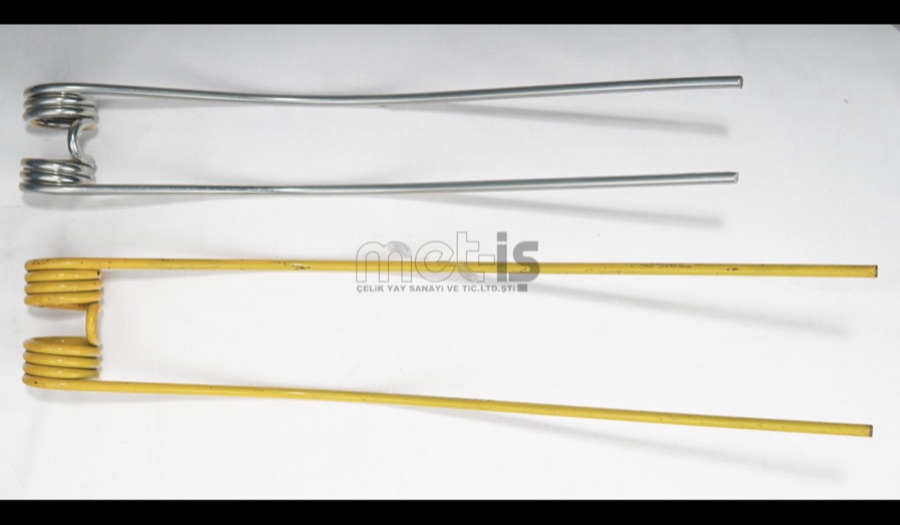
How a rotary rake differs from a trailed rake
On a trailed rake the tines are dragged along as the machine advances. On a rotary rake the arms take drive from a central gearbox and rotate continuously, so the tines sweep the crop rather than being pulled through it.
The difference shows up directly in the number of cycles the spring sees. A rotary rake tine is loaded far more often over the same area, which is why the same spring fatigues faster on this machine.
Rotary rake or wheel rake
Two types are compared in the field: the gearbox-driven machine with rotating arms, and the wheel rake whose tines are dragged along as the machine advances. Which one is better is among the commonest pre-purchase questions.
From the spring side the difference is this: on a wheel rake the tines are dragged, while on a rotary rake the arm takes drive from the gearbox and turns continuously. Over the same field the rotary rake tines see markedly more cycles, so the same spring fatigues faster there.
Both use torsion type form springs and the same rules apply; what changes is how often they need replacing.
What type of spring it is
A torsion type form spring. The body coil twists and the leg bends — the wire bends rather than twists. The modulus of elasticity is therefore used in its calculation rather than the shear modulus, and the result is a moment rather than a force.
In practice this means leg length and leg angle determine stiffness just as directly as wire diameter. Two different legs on the same body mean two different springs, so wire diameter alone is not enough when ordering.
In our catalogue 9 mm is a common wire diameter in this family, with separate items for Fimaks and Çelmak type machines.
Coil direction — the commonest mistake
A torsion spring must be loaded in the direction it was wound. Fitted the other way, the body diameter opens, the coils loosen on the shaft and life falls noticeably.
When a rake tine spring breaks early in the field the cause is more often fitting it the wrong way round than the material. Confirming coil direction before assembly prevents these failures entirely.
When to replace
Because the arms turn continuously, tines on a rotary rake see more cycles than on a trailed rake. A pre-season check matters even more in this group.
- The leg angle has openedIn a torsion spring fatigue shows as opening rather than breakage. If the spring no longer returns to its original angle even unloaded, it has reached the end of its life.
- The tine no longer takes a full biteAn opened leg skips over the crop; the windrow becomes uneven and pickup performance drops.
- Wear has started at the tipThinning at the tine tip is lost cross-section, and breakage starts there.
- Corrosion on the surfaceBending stress is highest at the surface, so rust here is a direct loss of life.
A row at a time, or one by one
Springs on the same arm see similar loads over a similar number of cycles and fatigue at a similar rate. If one has broken, its neighbours are close behind.
Replacing the row keeps the machine working evenly and avoids one failure after another in the field. Single-part sales are also available; the decision follows how hard the machine is worked.
What we need to quote
If you do not have these dimensions, we match on the make and model of the machine. Where there is doubt, a photograph of the old spring next to a ruler settles it.
- Wire diameterMeasured with a caliper from a sound coil in the middle of the body. 9 mm is common in this family.
- Body inside diameterThe governing dimension if the spring seats on a shaft.
- Leg lengthFor each leg separately. The longer the leg, the softer the spring.
- Leg angleThe angle between the two legs in the unloaded state.
- Coil directionRight or left hand. The spring must be loaded in the direction it was wound.
Frequently asked questions
Is a rotary rake tine spring the same as a hay rake spring?
They belong to the same family. Both are torsion type form springs; in our catalogue they are listed under hay rake springs.
Why do springs fatigue faster on a gearbox-driven rake?
The arms take drive from a central gearbox and rotate continuously, so the tines see far more cycles than on a trailed rake over the same area.
Which brands do you produce for?
Our catalogue covers hay rake springs for Fimaks, Çelmak, Krone, Gallignani, Gaspardo, Pöttinger, Massey Ferguson, Hisarlar and Turkish manufacturers, produced to original geometry.
How do I know if I have fitted the spring the wrong way round?
A torsion spring must be loaded in the direction it was wound. If it is reversed, the body diameter opens during operation and the coils loosen on the shaft.
Related pages
Cannot find the spring you need?
We produce to your dimensions in the 0.20–40 mm wire range, with no tooling dependency. A sample, a technical drawing, or simply a photograph of the old spring is enough.
Fill in the quote formOr call us directly: 0850 840 54 17