
Why Do Hay Rake Springs Open Out?
On hay rakes and tine machines the commonest reason for replacing a spring is not breakage but opening. The spring stays in place and looks sound, yet its leg angle has widened against the original and the tine no longer takes a full bite. This article explains the cause of that behaviour and when to act on it.
2026-09-123 min readMetiş Yay
How the load reaches the wire in a torsion spring
A hay rake spring is a torsion spring: the body coil twists and the leg bends. Unlike compression and extension springs, the wire here does not twist but bends — the load becomes bending stress in the cross-section. That is why the modulus of elasticity is used in its calculation rather than the shear modulus.
The difference carries into behaviour. In a section loaded in bending, stress is highest at the surface; fatigue begins there, and its first result is not fracture but permanent change of shape.
Opening is the sign the material has touched its yield limit
The spring is loaded through an angle and returns on every revolution. When the working stress rises above what the material can carry, the return is no longer complete; a very small permanent deformation accumulates on each cycle. After hundreds of hours that accumulation becomes a visible difference in angle.
Opening is therefore not a defect but the normal course of fatigue. What matters is reading it: once the leg angle has widened, the spring has reached the end of its life and breakage is a matter of time.
Four things that accelerate opening
- Fitting the wrong way roundA torsion spring must be loaded in the direction it was wound. Run the other way, the body diameter opens, the coils loosen on the shaft and life falls noticeably.
- A change in leg lengthThe longer the leg, the lower the moment needed for the same angle; the shorter it is, the stiffer the spring and the higher the stress. A spring running with a leg other than the original opens faster than expected.
- CorrosionRust removes cross-section at the surface. Because bending stress is highest at the surface, corrosion here is a direct loss of life.
- Skipped heat treatmentA spring not tempered after coiling still carries its coiling stresses; permanent deformation starts in the first season.
When to replace
No measuring instrument is needed for the decision: if the leg angle has visibly widened or the tine tip has worn, the spring should be replaced. Checking a whole row before the season is more practical than dealing with failures one by one in the field.
Because fatigue advances at a similar rate along the row, replacing the row gives a more even result. Renewing one spring in a row whose neighbours are still open does not give the full benefit.
Finding the right spring
Given body inside diameter, wire diameter, leg length and leg angle, no brand information is needed. If you do not have those dimensions, we match on the make and model of the machine.
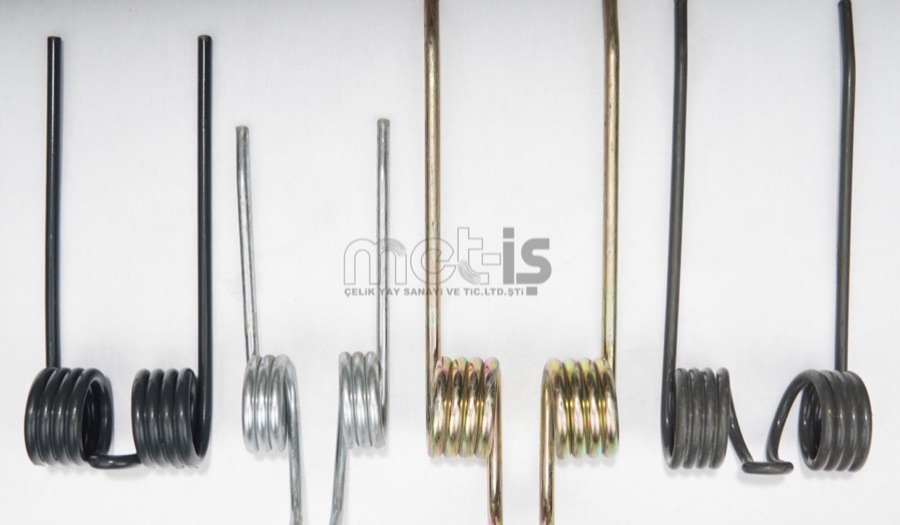
Hay rake springs in our catalogue are produced with silver, gold and black finishes; the coating is for surface protection and appearance, while the mechanical properties are set by the wire material and the heat treatment.
Frequently asked questions
The spring has opened but not broken — should I still replace it?
Yes. Opening is the first result of fatigue; the spring may look sound but it no longer gives its original force and breakage is a matter of time.
Does fitting a spring the wrong way round really shorten its life?
Yes. A torsion spring must be loaded in the direction it was wound; run the other way, the body diameter opens, the coils loosen on the shaft and life falls noticeably.
Does the coating colour change the strength of the spring?
No. Coating is for surface protection and appearance; mechanical properties are set by the wire material and the heat treatment.
Can I order without knowing the brand?
Yes. Given body inside diameter, wire diameter, leg length and leg angle, brand information is not needed.
Related pages
Cannot find the spring you need?
We produce to your dimensions in the 0.20–40 mm wire range, with no tooling dependency. A sample, a technical drawing, or simply a photograph of the old spring is enough.
Fill in the quote formOr call us directly: 0850 840 54 17