
Conical Springs
Compression springs whose diameter changes along their length so the coils can nest inside one another. Preferred where a long stroke is needed in a shallow installation gap.
How conical springs work
A conical spring is a compression spring coiled with a diameter that changes from one end to the other. That geometry has two consequences, both of them practical: because the coils can nest, the solid length drops to roughly a single wire thickness, and the spring stiffens as it is loaded.
The solid length advantage is decisive in mechanisms with a shallow installation gap. Achieving the same stroke with a straight cylindrical spring demands a much longer gap, whereas a conical spring can flatten almost completely. This is why the search spring on beet harvesters is usually conical.
The second property — rising stiffness — is what really separates a conical spring from a straight one. As the load grows, the largest-diameter coils close first and drop out of action; as the number of active coils falls, the spring rate rises. A conical spring therefore has no single spring rate: it changes through the deflection. Where a soft response under light load and a firm one under heavy load is wanted, this is a natural solution.
For the same reason one diameter is not enough in the calculation; the mean diameters at both ends are entered separately. The conical tab of our calculator uses k = G·d⁴ / (2·n·(D₁+D₂)·(D₁²+D₂²)) and reports the solid length on the basis of nesting.
The most frequently omitted figure when quoting dimensions is the small end diameter. If only the large end is given, the spring is taken to be cylindrical and its character changes completely. In our catalogue conical springs appear in beet harvester search springs and in the electronic contact springs of the seed drill group.
End types
The "end type" field on the quotation table expects one of these. On a conical spring the end form also decides which end seats — with the large end seated, the spring resists buckling better.
- Closed and ground — the last coil is laid against the body and the end face is ground flat. The form that transfers load most evenly.
- Closed, not ground — the last coil is laid down but no grinding is done. The most common form on agricultural and general machine items.
- Open, not ground — the coil pitch is kept at the ends. The most economical form; the spring does not seat perfectly flat.
- Seated end — whether the large or the small end seats is stated on the order. On a conical spring the two behave differently.
Material and standard
In a conical spring the coil diameter changes along the body, so the wire sees a different stress at every turn; the strength band of the material matters more than it does on a straight spring. Two wire families are used in production.
- Carbon spring steel wire — EN 10270-1. Known in the field as Ck67, Ck75, C60 and C70. Galvanised standard agricultural and machine items come from this family.
- Stainless spring wire — EN 10270-3. 1.4310, AISI 302 and 304 are different designations of the same family.
- Wire diameter range — the coiling line works between 0.20 mm and 40 mm.
- Class code — the SL, SM, SH, DM or DH code on the wire certificate marks the tensile strength band. Set out in the spring steel guide.
Dimensions we need for a quotation
One diameter is not enough on a conical spring — both ends must be measured.
| Dimension | What it means |
|---|---|
| Wire diameter · d | The diameter of the wire the spring is coiled from. |
| Large end outside diameter | Outer measurement of the coil at the wide end. |
| Small end outside diameter | Outer measurement of the coil at the narrow end. This is the figure most often omitted. |
| Free length · L₀ | End-to-end length of the spring with no load applied. |
| Coil count · n | Total number of coils. |
| End form | Closed and ground, or open end. |
Conical Springs calculator
Enter your dimensions and we will return the spring rate, solid length and spring index instantly — with a warning if the index leaves the healthy band.
Photographs from production
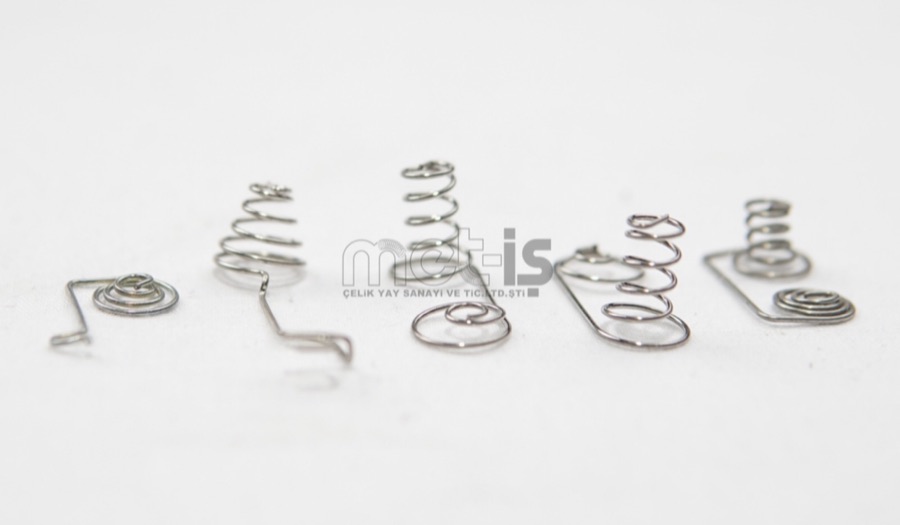
Which machine groups use it
Springs of this type appear in the following groups in our catalogue, each listed in detail on its own page.
How it is made
Every step after coiling happens in our own plant; nothing is outsourced. This shortens lead times and keeps quality responsibility in one pair of hands.
CNC coiling
Formed across the 0.20–40 mm wire range.
Tempering
Stress is relieved; elasticity becomes permanent.
End grinding
Seating faces are flattened on compression springs.
Galvanising
Surface protection against corrosion.
Packing
Domestic and export logistics included.
Frequently asked questions
Why choose a conical spring?
Because the coils can nest, the solid length drops to roughly a single wire thickness, giving a far longer stroke than a straight cylindrical spring in a shallow installation gap.
Does a conical spring have a single spring rate?
No. As the load grows the largest-diameter coils close first and drop out of action; as the active coil count falls the spring stiffens. The rate changes through the deflection.
How should I quote the dimensions?
Along with the wire diameter, the outside diameters at both ends must be given separately. If only the large end is quoted the spring is taken to be cylindrical and its character changes completely.
What is the difference between a conical and a straight compression spring?
A straight spring has a constant rate and a solid length of about (n+2)·d. A conical spring stiffens with load and its solid length drops to a single wire thickness.
Which machines use them?
In our catalogue they appear in beet harvester search springs and in the electronic contact springs of the seed drill group. They suit any application needing a long stroke in a shallow gap.
What if rising stiffness is not wanted?
If a constant rate is required, a straight cylindrical compression spring is the right choice. A conical spring is preferred when a load-stiffening character is wanted or when installation space is limited.
Other spring types
Cannot find the spring you need?
We produce to your dimensions in the 0.20–40 mm wire range, with no tooling dependency. A sample, a technical drawing, or simply a photograph of the old spring is enough.
Fill in the quote formOr call us directly: 0850 840 54 17