
Forage Harvester Springs
Ball springs and extension springs for forage harvesters — with hooked and threaded end options, including row-independent models.
About Forage Harvester Springs
On a forage harvester the spring keeps the cutting and pickup group following the ground surface. On row-independent models each unit works with its own spring, so any difference in force between springs upsets cutting height.
The decisive detail on the extension springs in this group is the end type: a hooked end fits quickly, while a threaded end allows the initial tension to be adjusted. Confirming the existing end type before ordering avoids surprises during fitting.
Our catalogue holds the Fimaks type row-independent forage harvester spring together with hooked and threaded ball springs.
Which machines it fits
The springs in this group are produced to the original dimensions of the machine brands below. If your brand is not listed, we still produce from a sample or from dimensions.
Product list — 3 items
The items below are supplied from stock or made to order. The link at the end of each row carries the product into the quote form.
| No. | Product name | |
|---|---|---|
| 59 | Fimaks type row-independent forage harvester spring | Request a quote |
| 60 | Forage harvester ball spring — hooked | Request a quote |
| 61 | Forage harvester ball spring — threaded | Request a quote |
Photographs from production
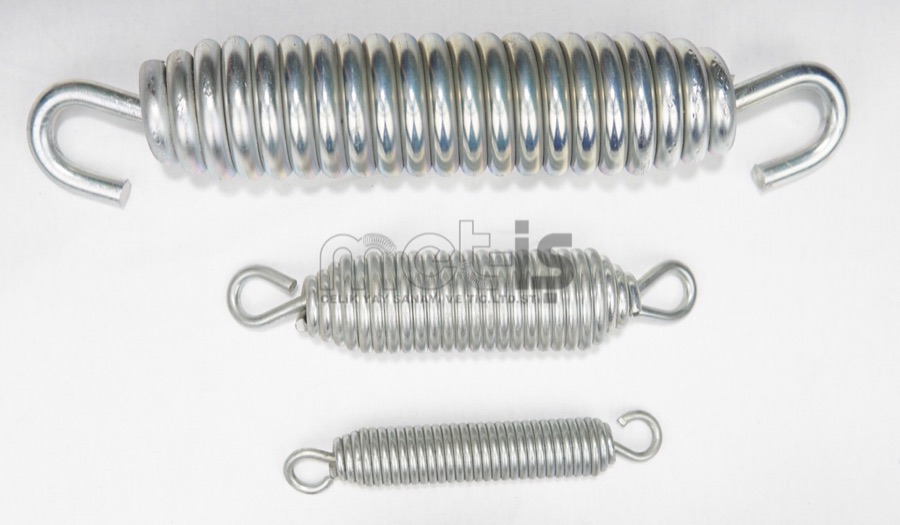
How it is made
Every step after coiling happens in our own plant; nothing is outsourced. This shortens lead times and keeps quality responsibility in one pair of hands.
CNC spring coiling
Formed in the 0.20–40 mm wire range.
Tempering
Stress is relieved and elasticity becomes permanent.
End grinding
Seating faces are flattened on compression springs.
Galvanizing
Surface protection against corrosion.
Packaging
Domestic and international logistics included.
FAQ
What is the difference between a hooked and a threaded ball spring?
A hooked end fits quickly; a threaded end lets you adjust the initial tension. The choice follows the existing connection type on the machine.
Should springs be changed together on a row-independent machine?
Yes, that is preferable. If force differs between units, cutting height varies from row to row.
Cutting height has become uneven — can the spring be the cause?
It can. When one unit's spring fatigues, that row works at a different height. Comparing free lengths is a quick check.
Do you produce for brands other than Fimaks?
Yes. Given a sample or dimensions, we produce regardless of brand.
Can you make an extension spring with initial tension?
Yes — on extension springs the initial tension is a production parameter and can be set to the required value.
How should I give you the dimensions?
Wire diameter, outer diameter, free length including hooks, and end type are enough. Failing that, a photograph of the spring next to a ruler works.
Which spring types this group uses
The pages below explain how these types work, which dimensions are needed to order them, and how to verify them in the calculator.
Other machine groups
Cannot find the spring you need?
We produce to your dimensions in the 0.20–40 mm wire range, with no tooling dependency. A sample, a technical drawing, or simply a photograph of the old spring is enough.
Fill in the quote formOr call us directly: 0850 840 54 17