
Çelmak Springs
The helicopter (windrow) spring for Çelmak type gearbox-driven rotary rakes — a double-legged rake spring form, made to original dimensions.
Çelmak items in our catalogue
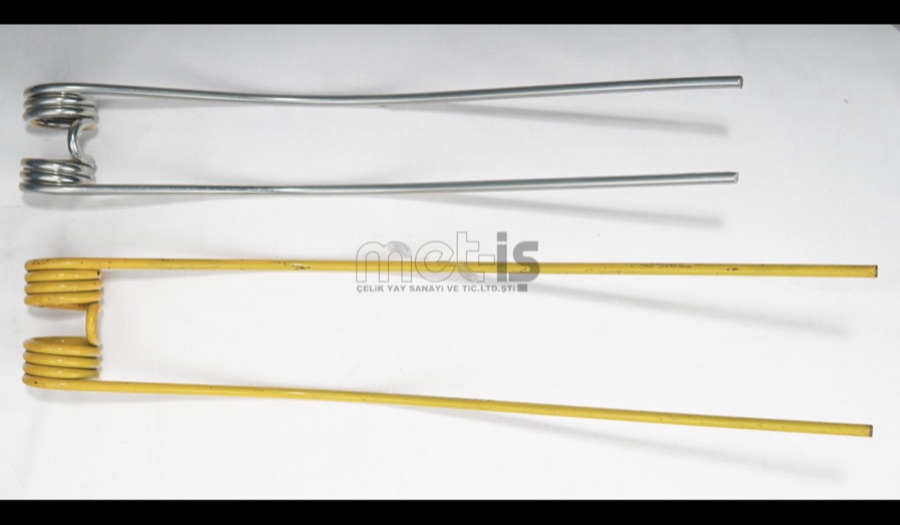
Our catalogue carries the Çelmak hay rake spring. The double-legged rake spring photograph in our gallery belongs to the same family: springs for Çelmak, Tümiş, Hisarlar and Fimaks type machines sit together in one frame. That is because the same form family runs in the pickup group of all four machines — body dimensions and leg forms are close to one another, though not identical; matching is still done by dimension.
In the field this machine is called a helicopter in Turkish, and the work it does is called windrowing. The same part goes by four names depending on the region: helicopter spring, windrow spring, rake spring, pickup spring. When looking for a spare part, all of them point to the same product.
The double-legged form is what distinguishes this family. The body coil takes the load in torsion and the two legs transfer it to the arm at two points. Its advantage over a single-legged spring is that it balances the moment on the arm and stops the leg from wandering sideways. The cost is this: if the angles of the two legs drift apart, the load piles onto one leg and that side fatigues quickly. On a spring that has been removed, each leg angle should therefore be checked separately.
Failure in this group usually progresses in the same order: first the leg angle widens (the spring opens), raking performance falls and the windrow stays ragged; then a fatigue crack starts at the bend where the body meets the leg; breakage comes last. In other words the spring stops doing its job long before it breaks. Comparing the free leg angle against the original is the most practical way to decide without waiting for a break.
Field conditions govern that life directly. Stony ground, tall stubble and ridges load the leg with impact; dry, hard crop raises the load taken per cycle. The same spring can give noticeably different life in two different fields — that is a difference in working conditions, not in quality.
Wire diameter, body (inside) diameter and overall length are enough to order. Wire diameters between 8 and 9.5 mm are the ones most often seen in this group, but they vary from machine to machine, so the dimension on your own part is what counts. If you cannot measure it, a photograph of the old spring next to a ruler is enough to make the match.
Product list — 1 items
The items below are supplied from stock or made to order. The link at the end of each row carries the product into the quote form.
| No | Product name | |
|---|---|---|
| 66 | Çelmak hay rake spring | Request a quote |
Photographs from production
Related machine groups
This brand's items sit in the groups below. The group pages also list the other brands produced for the same machine.
How it is made
Every step after coiling happens in our own plant; nothing is outsourced. This shortens lead times and keeps quality responsibility in one pair of hands.
CNC coiling
Formed across the 0.20–40 mm wire range.
Tempering
Stress is relieved; elasticity becomes permanent.
End grinding
Seating faces are flattened on compression springs.
Galvanising
Surface protection against corrosion.
Packing
Domestic and export logistics included.
Frequently asked questions
Are the helicopter spring, the windrow spring and the rake spring the same part?
Yes. A gearbox-driven rotary rake is called a helicopter in the field and the work it does is called windrowing; the torsion type form spring at the end of the rotating arm goes by all of these names. When looking for a spare part, all of them point to the same product.
Will a Çelmak spring fit a Tümiş or Fimaks machine?
The same form family runs in the pickup group of all four machines and their dimensions are close, but not identical. Matching should be done by dimension rather than by brand: wire diameter, body diameter and length settle which item you need.
What should I check on a double-legged spring?
Check each leg angle separately. If the angles have drifted apart, the load is piling onto one leg and that side is fatiguing quickly; it is time to replace the spring even if it has not broken.
The spring has not broken but the windrow stays ragged — why?
The spring has most likely opened. In this family failure begins with a widening leg angle rather than a break: the tip no longer takes a full bite and the crop does not form a clean row. Comparing the free leg angle against the original is enough to decide.
The same spring lasted less in the neighbouring field — is that a quality problem?
Usually not. Stony ground, tall stubble and dry, hard crop raise both the load per cycle and the number of impacts; the same spring can give noticeably different life in two different fields.
What wire diameter do I need?
Wire diameters between 8 and 9.5 mm are the ones most often seen in this group, but they vary from machine to machine. Give wire diameter, body diameter and overall length; a photograph next to a ruler is enough if you cannot measure them.
Can you make a Çelmak spring that is not in the list?
Yes. Our coiling line works across the 0.20–40 mm wire range with no tooling dependency; we produce from a sample, a technical drawing or dimensions.
Other brand pages
About the brand names
Metiş Yay is an independent spring manufacturer. The machine brand names on these pages are used solely to indicate which machines our products fit; they do not imply any authorised dealership, distributorship or official association with any brand. All brand names belong to their respective owners.
Cannot find the spring you need?
We produce to your dimensions in the 0.20–40 mm wire range, with no tooling dependency. A sample, a technical drawing, or simply a photograph of the old spring is enough.
Fill in the quote formOr call us directly: 0850 840 54 17